


As we enter the height of fantasy football draft season, I want to help IDP managers form the best possible strategy to dominate their fantasy football leagues and come away with a true league-winning result.
This first part of this draft strategy series covered how to leverage positional scarcity and stay ahead of the curve against the rest of your leaguemates. This second part of the series will focus on avoiding many of the crucial mistakes drafters have made in the past, so we can learn from them and avoid the same pitfalls in 2026.
Trust stability, avoid instability. Simple, right?
As noted at the top of Part 1 of this series, one of the biggest traps IDP managers tend to fall into is trusting the prior season’s fantasy production as their guiding light for who to trust in the coming year. The chart below highlights how much stable year-to-year fantasy production (Big-3 Scoring) tends to be at each position, as well as how IDP drafters tend to draft based on last season’s results. A perfect correlation is 1.00 with this data.
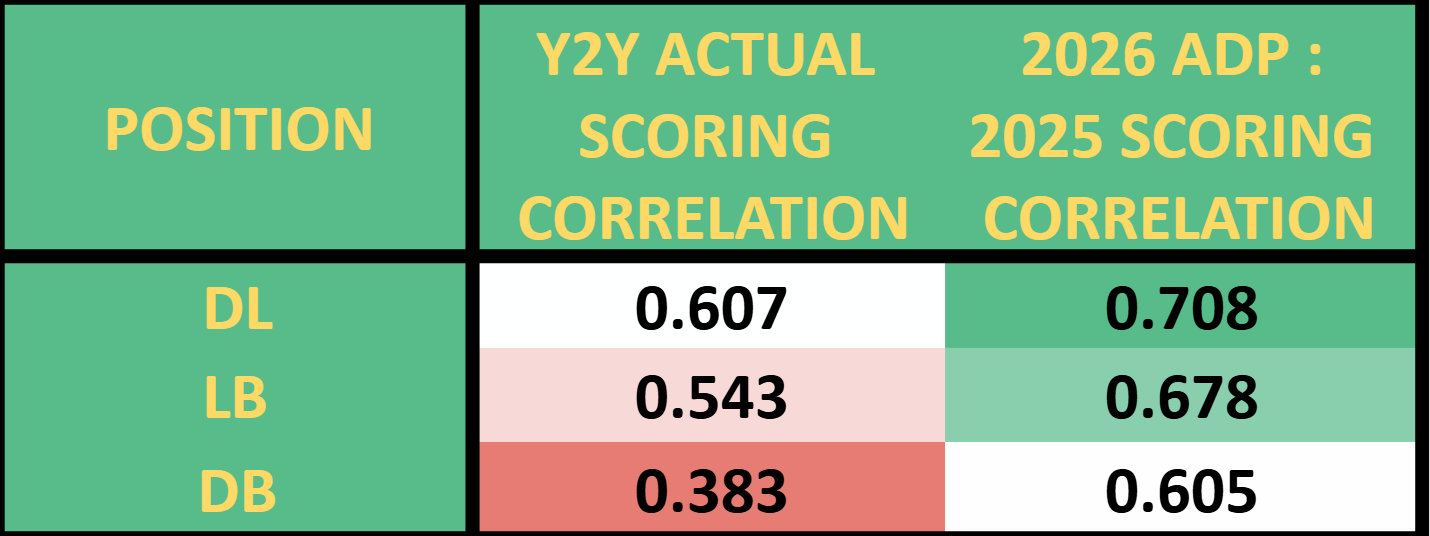
Understanding that there is significant variance in fantasy football, especially in IDP, is really the first step to setting yourself up for a grounded approach to your draft. We’re still going to gravitate toward past top performers, but introducing nuance into that thought process can help eliminate red-flag performers and provide an edge toward finding the next top performers.
It happens every season where new top scorers make up the majority of the highest scorers in IDP. Pulling data from 2022-2025, the chart below shows retention rates from year to year across those seasons at each position.
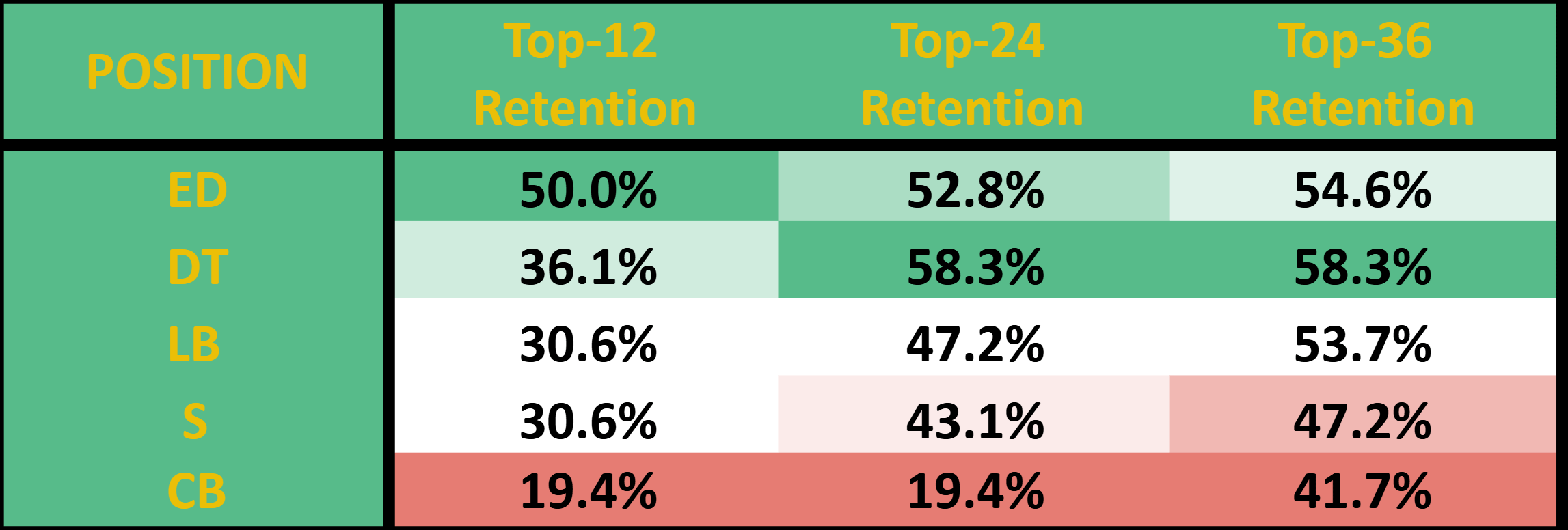
Building off Part 1 of this series, where I covered leveraging positional scarcity and targeting the EDGE position heavily as the first IDPs off the board, this retention rate chart should have you feeling even better about that strategy. Repeat scorers at defensive line are significantly more common than any other position in IDP, helping to reduce the risk and guesswork in finding the potential ED1. Of course, there are still those that don’t return their ADP value, and we’ll get into some of the non-injury-related reasons why shortly.
Harkening back to the year-to-year ADP correlation to previous seasons’ top performers, IDP managers are at least repeat-drafting the correct positions in the correct order. We’re still a little too trustworthy, but we’re on the right track. The main way to make up the difference will likely come from identifying why certain players didn’t repeat (injuries aside) and seeing if we can identify the archetypes to avoid in the future.
Positional red flags
Aside from injuries, each position tends to have its own unique reasons for why they can’t repeat their success from the previous season. Understanding those reasons and identifying any common denominators should help us avoid the players most likely to “bust” at the position and, alternatively, help us know which ones to trust.
LINEBACKER
Everyone’s favorite position in IDP, the linebacker player pool is deceptively deep and creates more annual variance than most fantasy managers realize, as highlighted in the charts above.
This next chart breakdown looks at the percentage of linebackers classified as misses (finishing 10 or more spots lower than their ADP) as well as the average number of picks in value that drafting and missing cost us in that range. This includes those that returned value or greatly outperformed their ADP as well as injury-related misses.
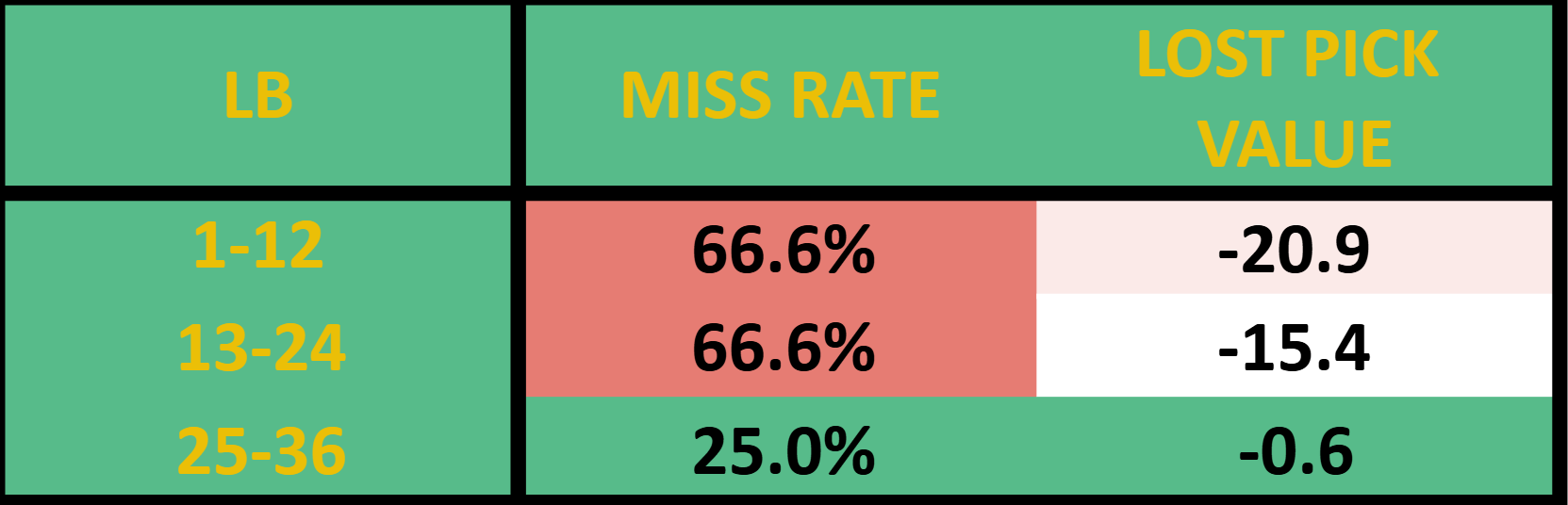
Fred Warner and T.J. Edwards were drafted as the LB4 and LB5, respectively, last season, though both players missed significant time due to injury, so they obviously couldn’t return their appropriate value, but this happened at every position. It will happen at every position every year, and it’s unavoidable, but we also don’t need to analyze what went wrong there.
Herein lies the risk of trying to draft linebackers at their ceiling: for the most part, they’re much more likely to disappoint, which makes it increasingly risky to draft them in the top-12 when considering the flatter production curve highlighted in Part 1 of this series.
Only one of the four players who were able to avoid being considered misses within the top-12 at linebacker actually improved on their ADP (Jamien Sherwood, LB12 > LB8). The rest (Zack Baun, Foyesade Oluokun, Kaden Elliss) can only be described as minimizing the damage done to those who invested highly in them. Herein lies the risk of trying to draft linebackers at their ceiling: for the most part, they’re much more likely to disappoint, which makes it increasingly risky to draft them in the top-12 when considering the flatter production curve highlighted in Part 1 of this series.
That flattened production curve also explains the minimal miss rate and lost value once we’re drafting LB25-36. This is where players like Jack Campbell, Bobby Wagner, Quay Walker, Germaine Pratt, and even Carson Schwesinger could be found last season. All of whom were among the projected full-time players at the position heading into the season and the perfect candidates to target later, when attacking the defensive line position early.
DEFENSIVE LINE (EDGE & DT)
Speaking of the defensive line position, and the EDGE position, in particular, we’ll focus on that position next to compare against linebacker, specifically, to further make a case as to why targeting high-end EDGEs is the preferred strategy.
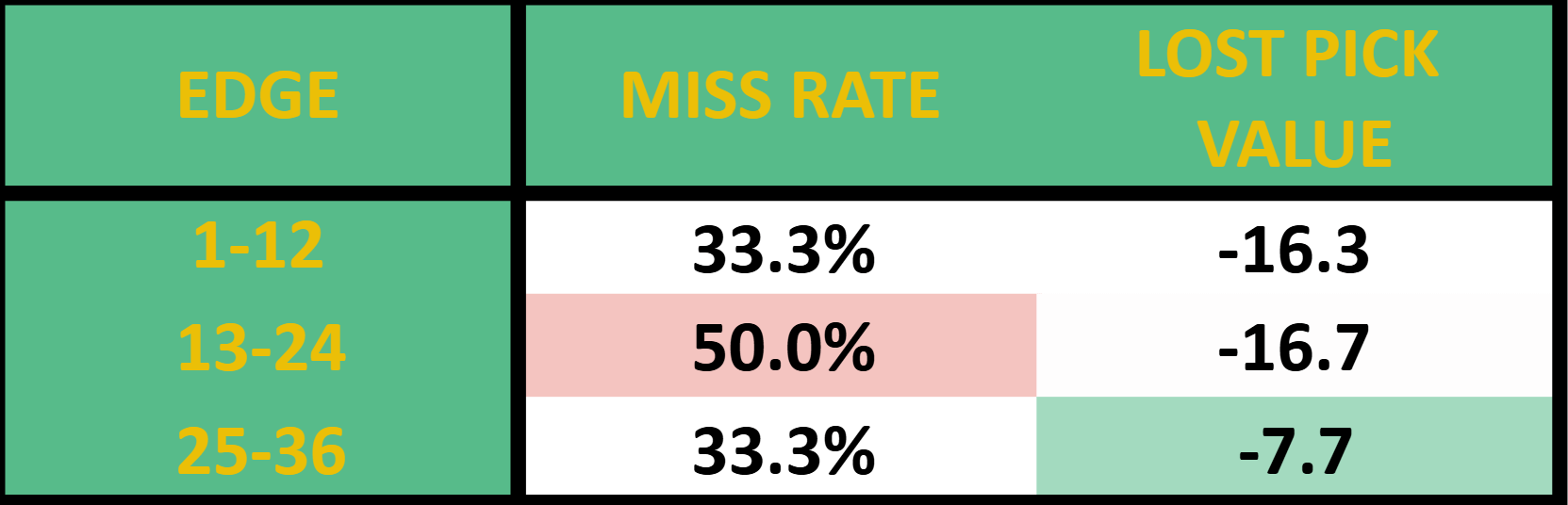
Thanks to more stability at the position, the EDGE position is much more forgiving in terms of value lost and just “busts” overall. The biggest misses at the position (Nick Bosa and Trey Hendrickson) were a result of season-ending injuries, accounting for 21 missed games from those two alone. It’s also the only position that produced a legitimate “hit” (finishing 10 or more spots above ADP) within the top-12, as Brian Burns was drafted as the ED12 and finished as the overall ED2.
Not only is the risk minimized when drafting the top EDGEs, but by betting on talent and paying attention to the underlying metrics, we’re more likely to find the top overall scorer at the position from that top tier. Even when accounting for injuries and players that missed time, which caused them to lose value from their ADP, Nick Bosa, T.J. Watt, and Micah Parsons still produced at an ED1 rate in points per game before departing. This isn’t typically the case for the other positions.
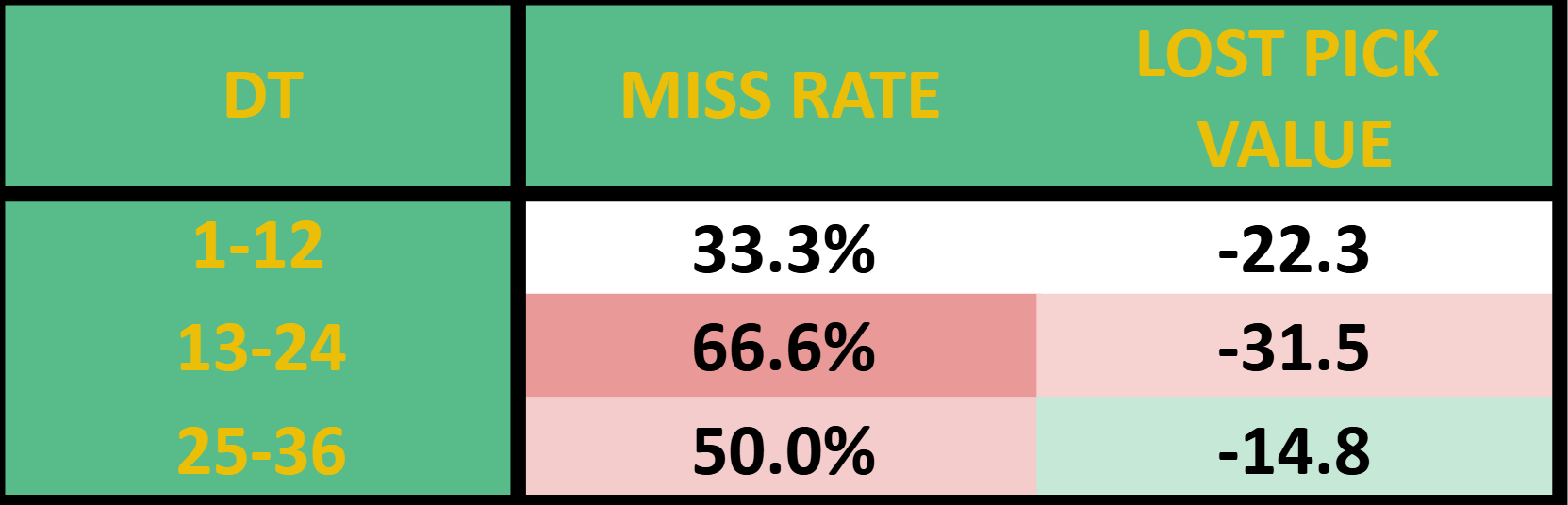
Defensive tackle offers a similar level of reliability to the EDGE position from the top 12; however, beyond that, the penalty for missing becomes greater. For DT-required formats, this should further support the importance of locking down a top-tier player at the position as that player pool dries up quickly, lowering the floor and our potential hit rates due to limited ceilings beyond the elite players at the position.
DEFENSIVE BACK (SAFETY & CB)
As expected, the potential to break through any of the top 36 draft ranges at defensive back is typically higher than any other IDP position. However, one position is a greater offender than the other, so we’ll start there. The cornerback position.
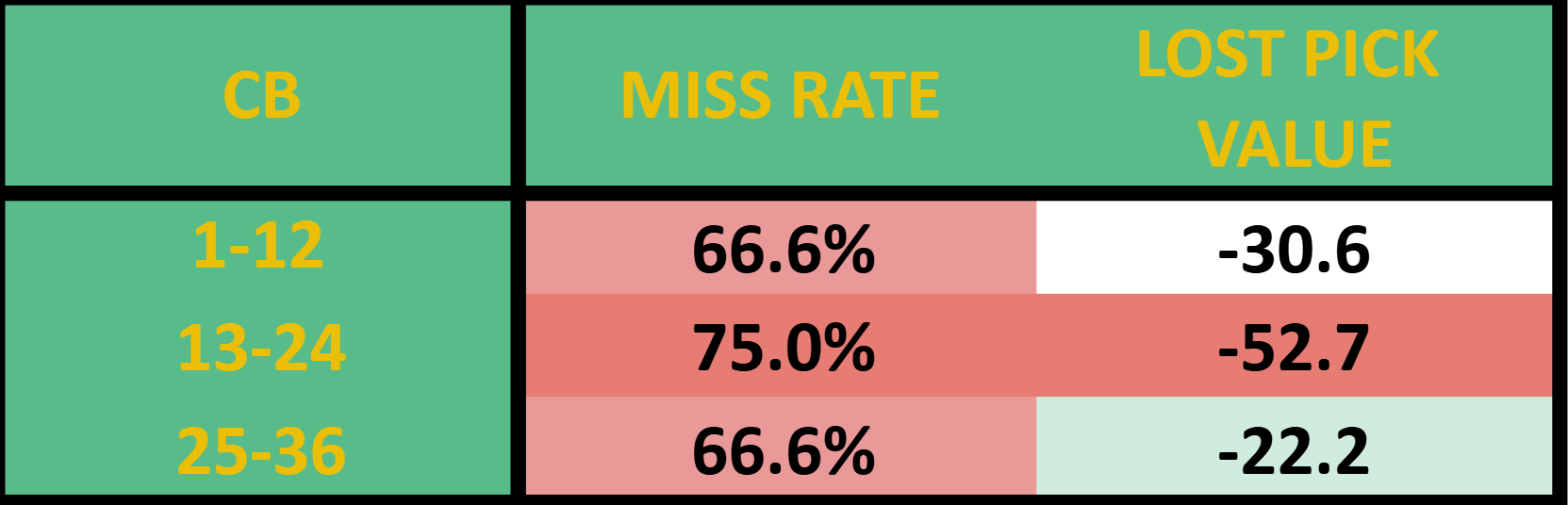
IDP managers in general are not good at drafting cornerbacks, and it’s costing significant value in drafts. As highlighted at the very top of this article, a big reason for this is not recognizing that year-to-year fantasy production is wildly unstable for the position, leading them to just draft last year’s top performers and hope for more of the same. Unfortunately, this is the last position we should expect that outcome, and it's even more reason to fade the position until the final rounds of our drafts.
This also tells me that IDP managers are not as locked in when it comes to cornerback rankings, or just don’t care enough to pay attention to the position, knowing that if they miss, they can most likely stream the position off the waiver wire in-season. And that’s fine. The position is deep enough to stream comfortably in most formats, but at the same time, we shouldn’t spend up to draft a top-12 CB knowing there’s little to no payoff, even if you do manage to survive that risk.
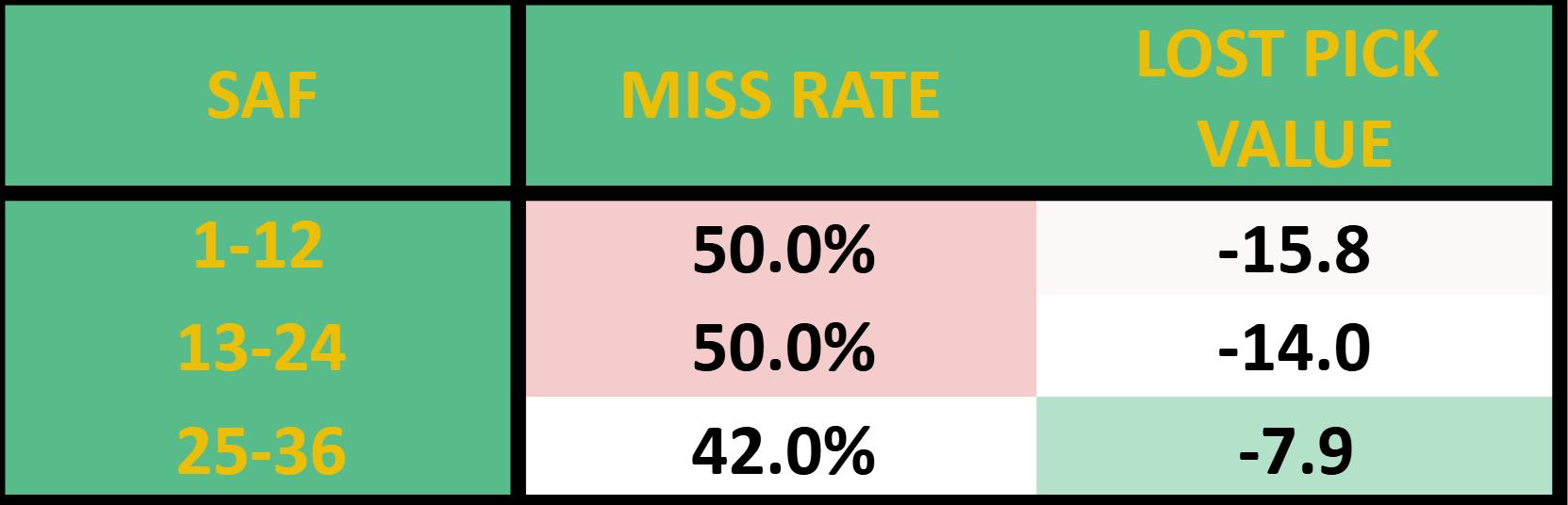
The safety position is nearly just as risky to bet on, with high variance in yearly scoring and a massive player pool to pull from, all capable of outperforming their ADP.
The difference at safety from the CB position, though, is that the value loss isn’t nearly as detrimental to IDP managers who are willing to take the risk. Because the position performs so similarly across the top scorers, highlighted by the flatter production curve in Part 1 of this series, we’re not penalized as much by our misses. However, it also means that the payoff isn’t worth the investment, so much like the cornerback position, we can continue to be patient and wait until the latter rounds before drafting our starting safeties.
Learning from the “busts”
As noted in the previous section, not all of our top performers are going to repeat their success from the year prior, and in fact, most of them will not. To increase our odds of finding the ones who can and will repeat, we need to weed out the ones most likely to bust. Major injuries aside, I’ll highlight the most notable “misses” (players who finished 10 or more spots below their ADP) at each position, identify why they didn’t succeed, and then try to tie those archetypes to players being drafted highly this season, to avoid the same traps.
LINEBACKER
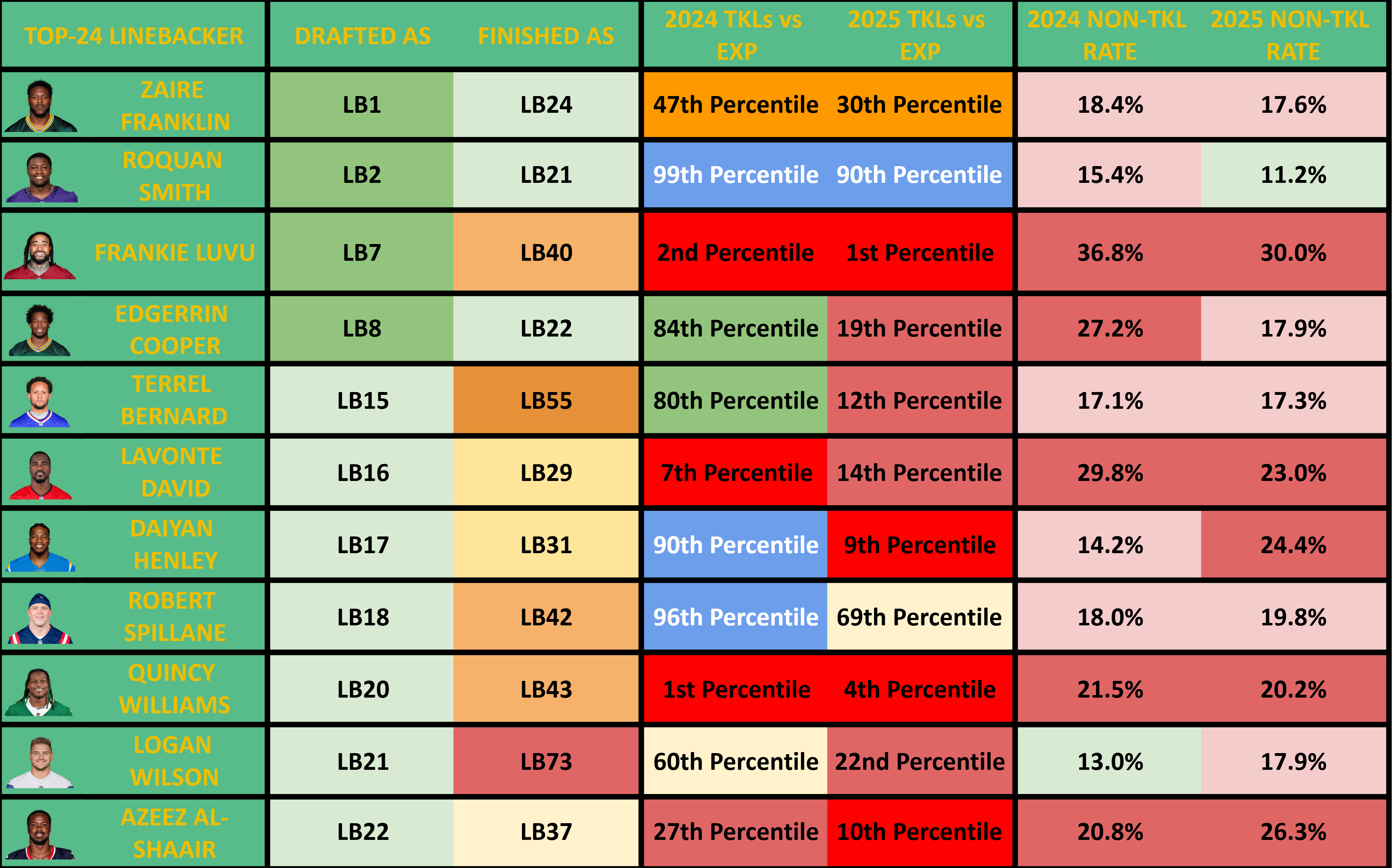
LB RED FLAG INDICATORS:
AVERAGE - BELOW AVERAGE TACKLING
Zaire Franklin, Frankie Luvu, Lavonte David, Quincy Williams, and Azeez Al-Shaair all entered the 2025 season coming off below-expected tackling performances from the following year.
Unfortunately, none of them were able to overcome this trait/production in 2025, which put a significant dent in their ability to return the value for which they were drafted.
Ineffective tackling is often stickier year-to-year than overly efficient tackling, which should lower our expectations for those who underperformed the previous season.
UNSTABLE BIG-PLAY PRODUCTION
Only Logan Wilson performed in a safer below-average (13.5%) range of big-play production from the previous season.
However, he lost his job, which cost him all of his IDP value. This wasn’t completely unexpected as the team drafted two rookie linebackers within the first four rounds of the 2025 NFL Draft.
Zaire Franklin, Roquan Smith, Frankie Luvu, Edgerrin Cooper, Lavonte David, and Quincy Williams all produced an above-average rate of big-play production in 2024, which was always going to put them in danger of negative regression in that regard heading into 2025.
Franklin, Smith, Luvu, Cooper, David, and Williams all regressed as expected, and even though they still delivered above-average production, combining that dip with low-end tackle efficiency sank their value enough to qualify as ADP misses.
THE OUTLIERS
Daiyan Henley, Robert Spillane, and Terrel Bernard all performed as elite tacklers in 2024 but dropped off dramatically in 2025, which is bound to happen to some, and not always predictable.
For Spillane, he went from one of the more zone-heavy defenses in Las Vegas to a man-heavy unit in New England, so some drop-off should have been expected.
Henley and Bernard’s situation didn’t change all that much, so they’re the only ones who can really qualify as true outliers.
What we’re really looking for are linebackers with multiple red flags in tackle efficiency (represented by Tackles versus Expected) and big-play production. Sometimes this is really obvious, as was the case with Frankie Luvu and Quincy Williams. Others are more subtle, like with Lavonte David and Azeez Al-Shaair, but it pays to temper expectations for these types.
2026’s ADP RED FLAGS: LINEBACKER
Heading into this season, there are eight clear examples worth looking at being drafted among the top-24 linebackers according to our ADP.
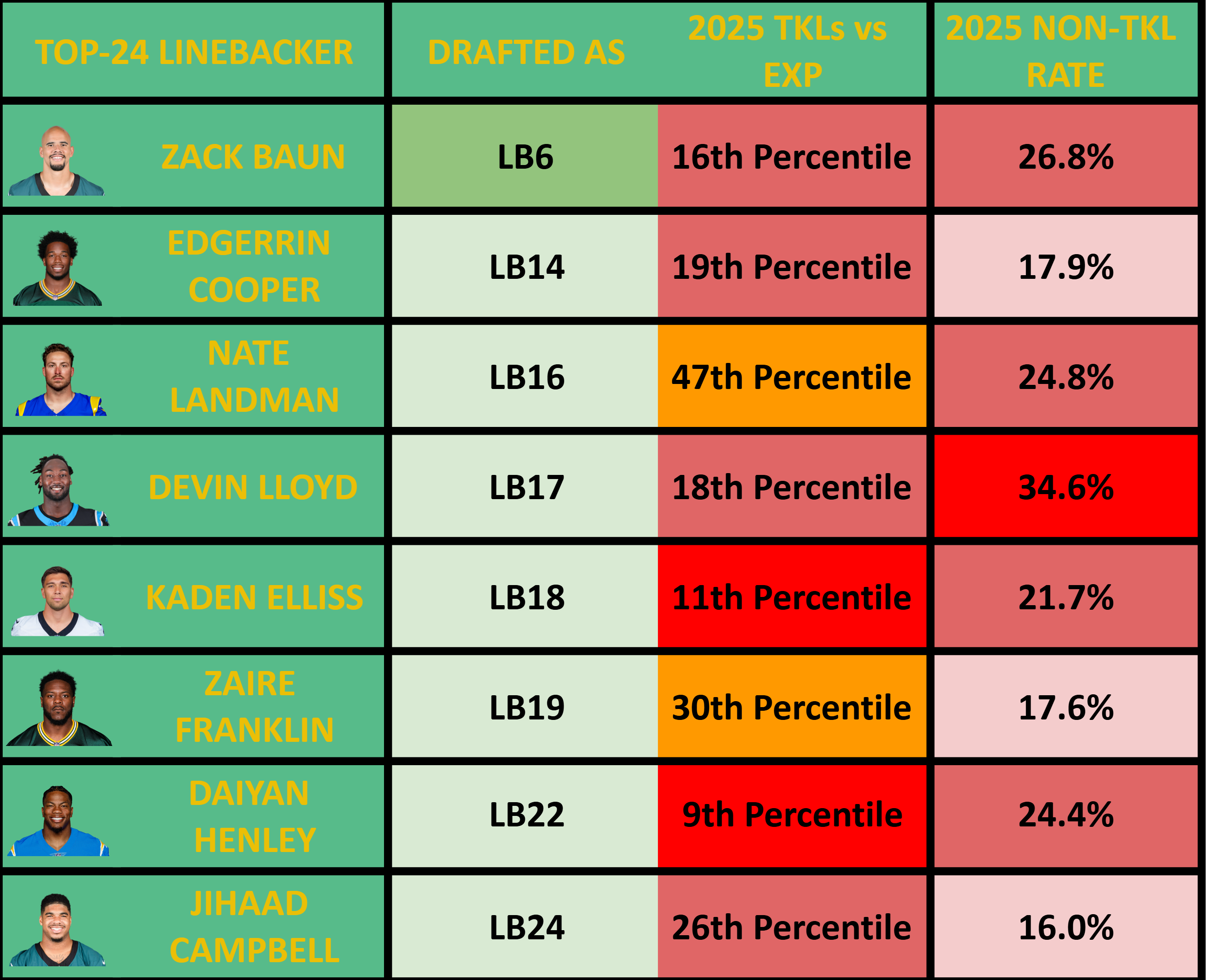
THE BIGGEST RISKS
Zack Baun and Edgerrin Cooper are being drafted highest among these potential red-flag players this year, and both are at the highest risk of not returning their ADP value.
Baun’s production profile and usage within Vic Fangio’s defense are now that of a boom-bust type option relative to the position, where he’ll need those big plays to overcome the low-end tackle production.
Considering his very high price tag, he’s a risk we should be avoiding at cost.
Cooper offers similar concerns, though a new defense where he’s not the one wearing the green dot puts him at risk of coming off the field more than we’d like from a top-15 LB as well.
Jonathan Gannon does not have a history of two every-down linebackers, and with Cooper not manning the dot, his production and snap risk should move him down the ranks.
MILD CONCERN
Devin Lloyd and Kaden Elliss are both risks at their current ADP, but as highlighted here, their situations should improve significantly for better tackle production and help them overcome their concerns.
These are certainly more high-risk plays, but probably the only ones I’d truly feel comfortable with heading into 2026 considering their projections.
Both Nate Landman and Zaire Franklin are expected to be every-down linebackers in their defenses, and while coming in below average in Tackles versus Expected, they play in friendly enough defenses for tackles while coming at a reasonable price, so I'm not overly cautious on their 2026 value.
Daiyan Henley and Jihaad Campbell are both linebackers who should have better seasons in 2026, and their prices aren’t egregiously high, though I’d still feel more comfortable with them a little later in drafts, if possible.
EDGE DEFENDERS
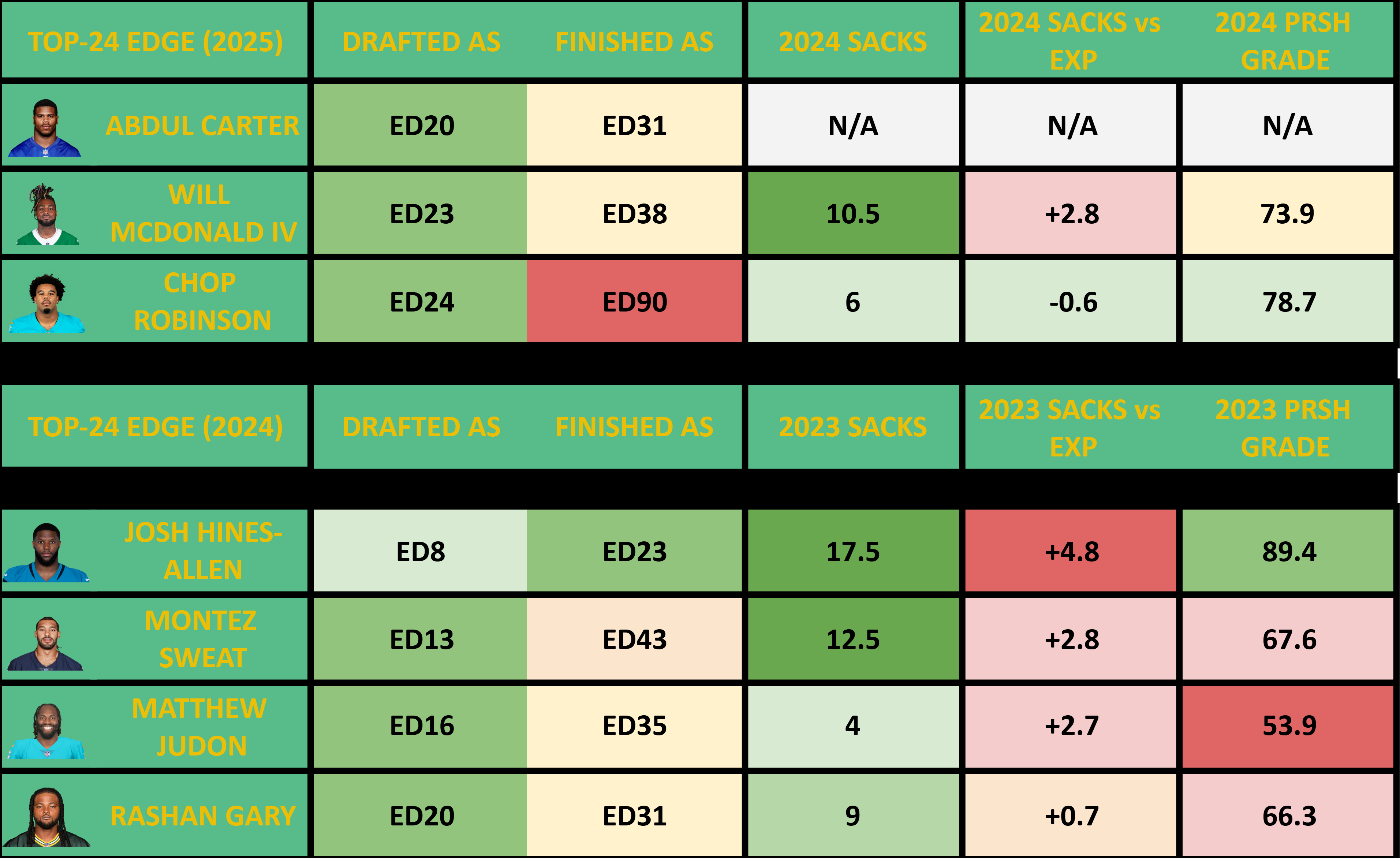
Injuries have been by far the greatest killer for our highly-drafted EDGEs, with most “busts” missing three or more games. So, with a smaller group to pull from, I’ll dip into the non-injury-related misses from 2024 to add to this dataset as well. Defensive tackle misses were almost exclusively injury-related, so we’ll skip that position in this exercise.
EDGE RED FLAG INDICATORS:
OVER-ACHIEVING IN THE SACK COLUMN
Will McDonald (2025), Josh Hines-Allen (2024), Montez Sweat (2024), and Matthew Judon (2024) all delivered more than 2.5 sacks over expected from their previous seasons, which is about the threshold where that production becomes difficult to maintain.
Making those sack totals even harder to maintain are below-average pass-rush metrics, specifically PFF pass-rush grade.
Only Josh Hines-Allen delivered a pass-rush grade above 75.0 in his over-achieving season, and with his sack totals coming so much higher than expected, he was still a strong regression candidate.
JUMPING THE GUN ON EXPECTED DEVELOPMENT
In the case of Abdul Carter and Chop Robinson, both players were first-round picks that the IDP community was hopeful could deliver immediate production.
While Robinson showed promise in Year 1, IDP drafters chose to ignore the snap competition (Jaelan Phillips & Bradley Chubb) returning from injury that would limit his playing time and production in Year 2.
Carter is also a case of ignoring competition for snaps on a crowded New York Giants defensive line, but also being impatient with overall development, as Year 1 is rarely going to be overly productive, even for a highly-drafted EDGE.
For all defensive linemen, the concern in drafting them highly is going to come from repeatable sack/big-play production. For that production to repeat, we’ll want to see those underlying metrics be encouraging enough to suggest they can deliver again, as well as a little bit of luck, because even the best pass rushers aren’t immune to sack regression.
2026’s ADP RED FLAGS: EDGE
Heading into this season, there are five examples worth looking at being drafted among the top-24 EDGEs according to our ADP.
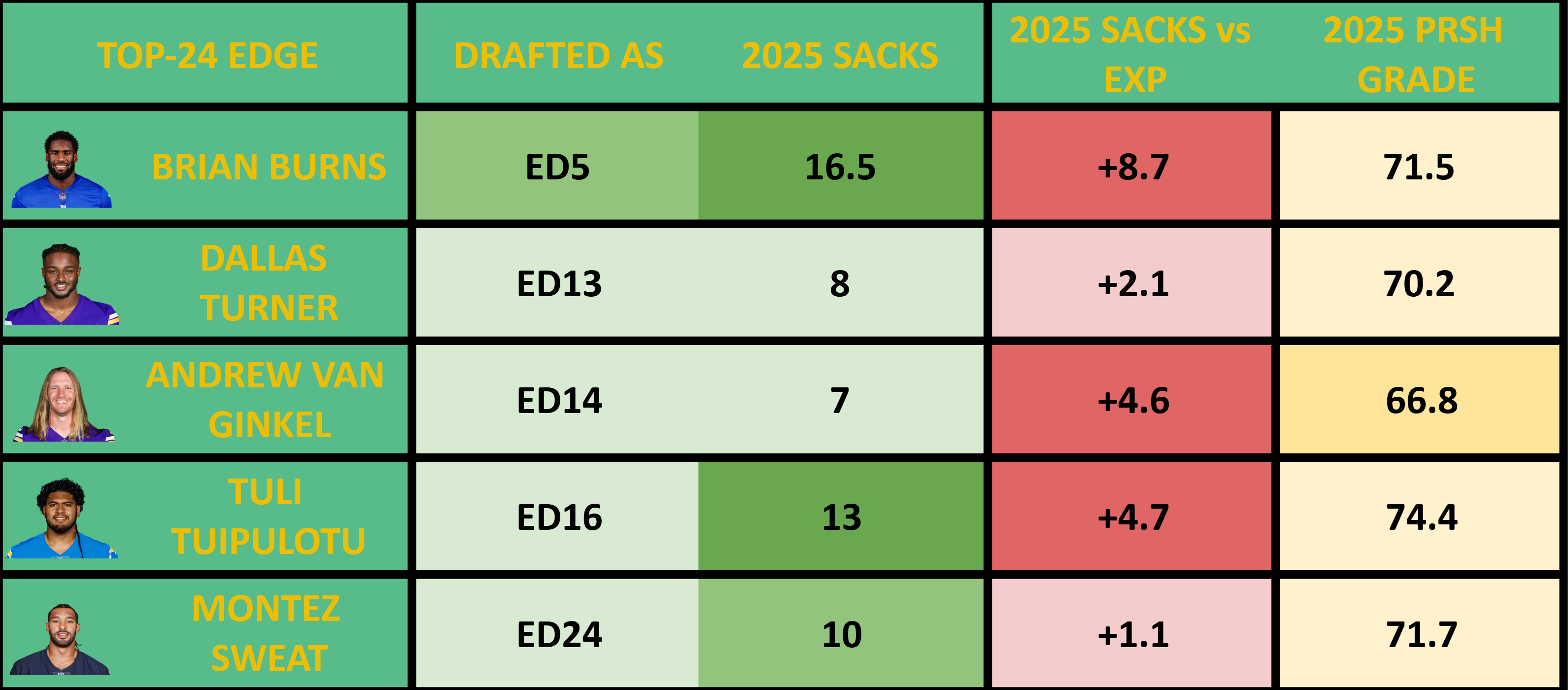
THE BIGGEST RISKS
Brian Burns is a clear sack regression candidate coming off a career-high 16.5 sacks in 2025.
Burns is a very good IDP and NFL player, but with two clear red flag indicators in his sub-75.0 pass-rush grade and massive discrepancy in Sacks versus Expected, he’ll be the most hard-pressed EDGE to return his top-five ADP.
Andrew Van Ginkel has been the definition of an overachiever in the NFL and especially as an IDP in recent years.
2026 is shaping up to be the year where Van Ginkel finally disappoints relative to his ADP.
He owns by far the lowest pass-rush grade (53rd) from those being drafted among the top-24 at his position, and outside of one season, that has been the norm for his career.
He’s more than due for significant regression, and after avoiding that for so long, don’t be surprised if this, his age-31 season, is the year he can’t deliver top-24 production.
Tuli Tuipulotu is another EDGE who is coming off a great season as an NFL player and IDP, delivering a career-high 13 total sacks.
Tuipulotu isn’t as big of a risk as Burns and Van Ginkel since he owns a reasonable ADP, but he is still primed for some regression.
He just barely misses the threshold for the pass-rush grade red flag, but more than anything, delivering the second-most sacks versus expected from this group is something to be aware of when it’s time to draft.
MILD CONCERN
With Dallas Turner entering a crucial Year 3 development season and coming within 2.5 sacks of expected, he has some risk, but not nearly as much as others.
He’ll have to maintain a high-end snap volume this year, which is expected, and if he can take a leap in his pass-rushing development, also as expected, then he’ll be a fine pick in this range.
Montez Sweat’s bounce-back season in 2025 was very encouraging after being one of the red flags a year prior.
Sweat delivered better pass-rush metrics and is now being drafted at a reasonable enough price that he shouldn’t burn IDP managers too much with a slightly lower projection.
SAFETY
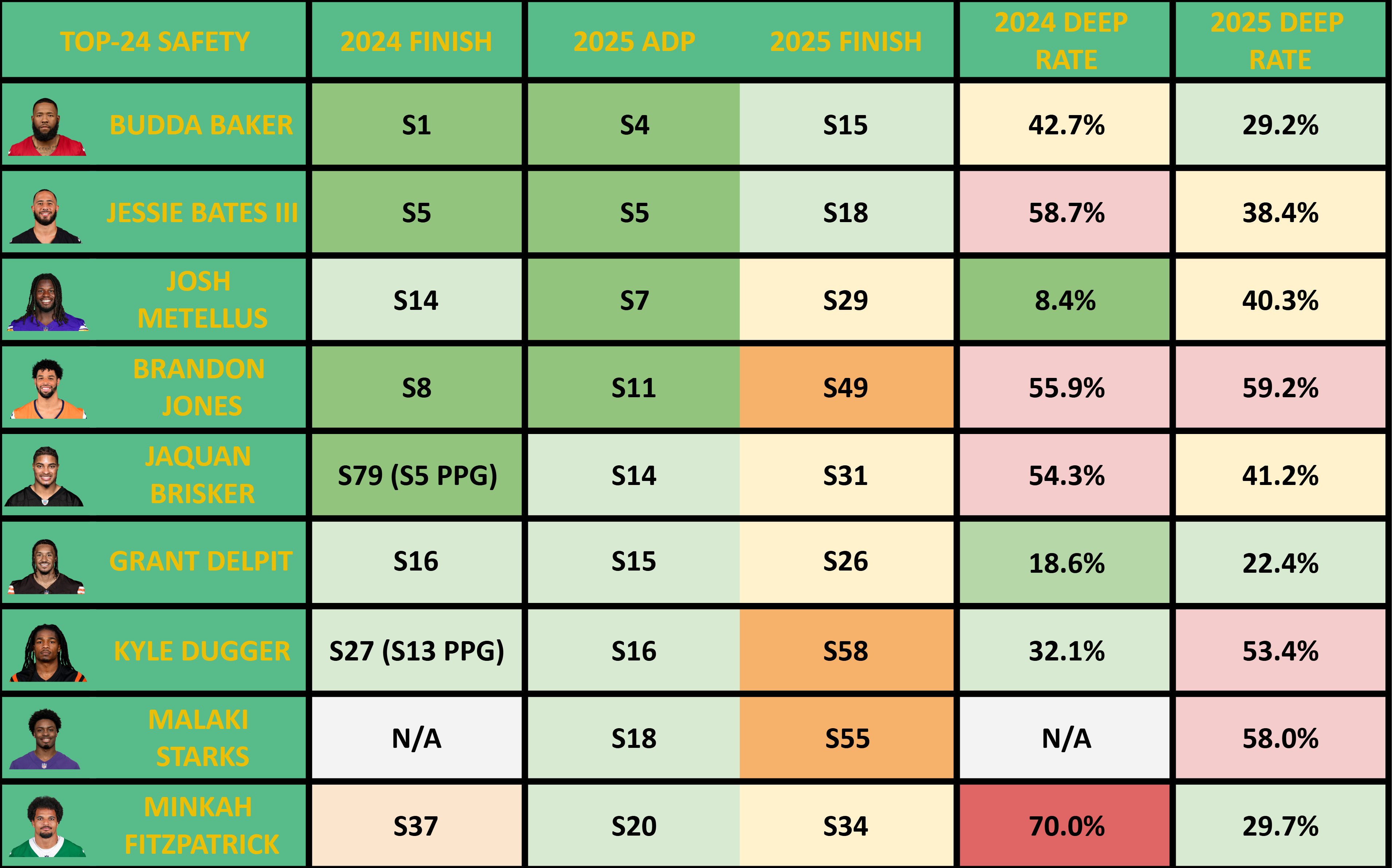
Defensive back IDP production is by far the most unstable each season, which naturally creates significant turnover among the top scorers and creates a higher “bust” rate.
The same is true at cornerback, though there’s the added bust potential of IDP managers drafting familiar elite NFL cornerbacks like Pat Surtain II, Derek Stingley, Sauce Gardner, and Christian Gonzalez who were all top-20 in ADP at the position last season, despite limited IDP potential.
SAFETY RED FLAG INDICATORS:
DRAFTING BASED ON LAST YEAR’S FINISH
As highlighted at the very top of this article, IDP managers are inclined to draft based on last year’s production, though that is especially damaging at DB where production rarely repeats.
You’ll notice a lot of similarities in the chart above where each of these concerning safeties is being drafted close to where they finished in 2025.
POOR SCHEME/USAGE
Josh Metellus, Brandon Jones, Jaquan Brisker, Kyle Dugger, and Malaki Starks all played well over a third of their defensive snaps from a deep alignment last season, most of which could have been predicted by the season prior or offseason news/changes.
For Metellus, specifically, his role change was a concern with Cam Bynum’s departure, leaving a hole at deep safety that he’d likely have to help fill, eliminating the elite usage we fell in love with him for in prior seasons.
Dugger’s role was clearly being reduced in training camp and the preseason with news of him not starting in New England anymore, and IDP managers who adjusted on that news avoided the penalty, but for those not locked in, it cost them.
DRAFTING NAMES VERSUS PROJECTION
Sometimes familiarity creates comfort in our draft decisions, and this is especially true for those not following seasonal rankings or projections, as they’ll just take the player whose name they know best when things get tough.
Minkah Fitzpatrick is a well-known IDP commodity, though his production has declined in recent years; that hasn’t stopped drafters from expecting him to produce top-24 numbers.
Malaki Starks’ ADP should never have been this high, with his projected role in Baltimore always expected to be more of a deep safety with Kyle Hamilton there, though his first-round draft capital clearly had a lot of drafters feeling the rookie fever.
Jessie Bates is another example of a player who has overperformed in recent years, and he comes with strong NFL name value. His big-play production has boosted his IDP value, though once that predictably declined even slightly in 2025, he was unable to return to that top-five IDP value.
NATURAL REGRESSION
Knowing the instability at the position, overperformers should almost always be avoided, whether it’s efficient big plays or tackles that boosted them up the year before.
Budda Baker was never going to deliver as many tackles as he did in 2024, and even with a relatively strong season in 2025, he was technically a “bust” at the position.
Brandon Jones also greatly overperformed as a tackler, finishing in the 98th percentile in Tackles versus Expected in 2024, but with added competition at his position in the form of Talanoa Hufanga, combined with natural regression, he too could not repeat as a top-12 IDP safety where he was being drafted.
Jaquan Brisker was incredibly efficient as a tackler in his limited 2024 sample, which had IDP managers expecting more of the same on a larger sample size in 2025, though he too failed to live up to those expectations.
It’s not always the IDP safety themselves that are at fault for not returning their expected ADP value, but almost entirely a result of the thin-margined positional scoring and heavy production variance. Knowing this should hammer home the point even more: don't draft safety early!
2026’s ADP RED FLAGS: SAFETY
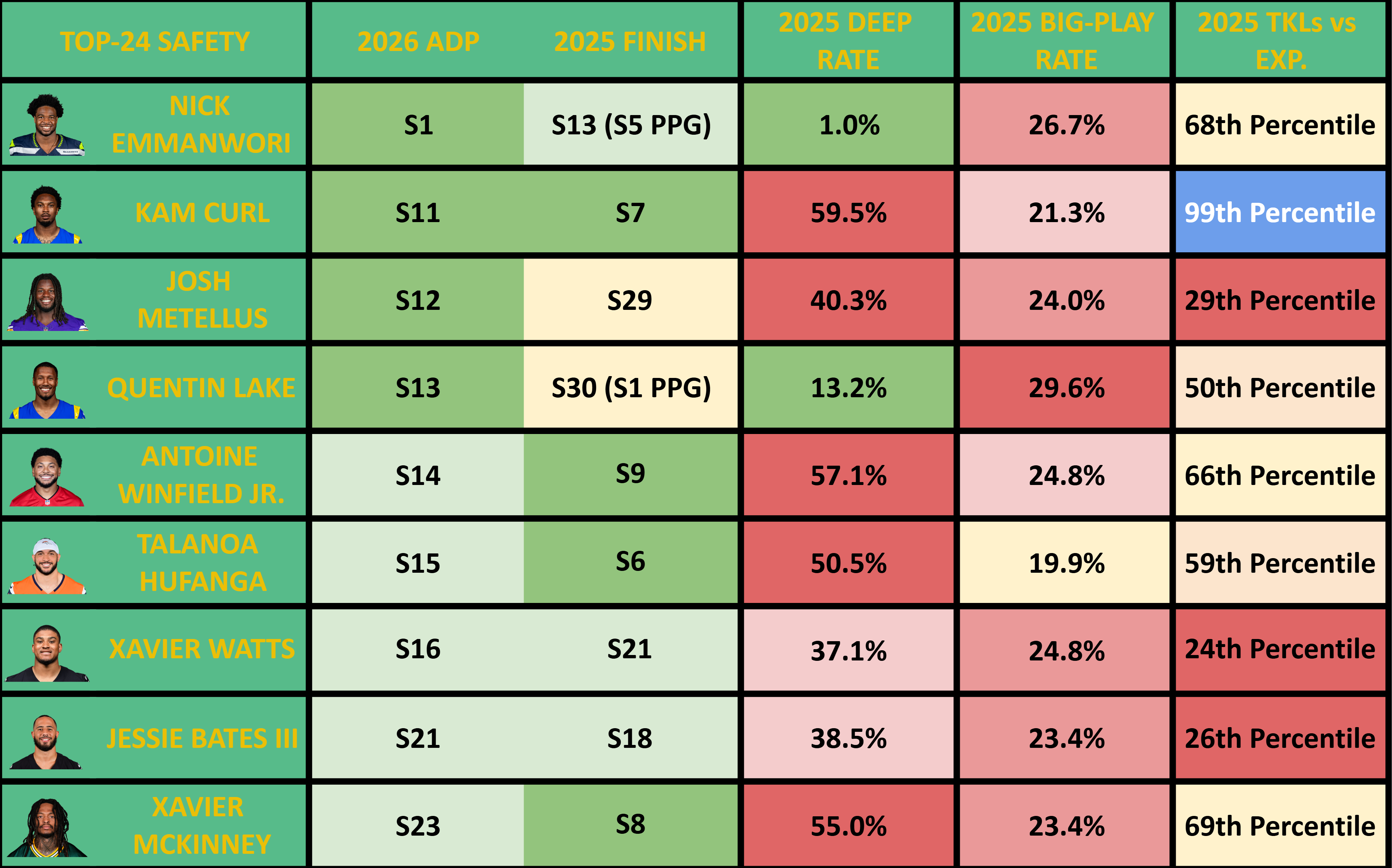
While pretty much every top-12 safety in ADP can be highlighted here, I’ve picked out nine clear concerning players to be wary of being drafted among the top-24 SAFETIES according to our ADP.
THE BIGGEST RISKS
Anytime we’re drafting a safety early, we’re likely to be disappointed with the return on investment. Again, it’s not necessarily the player’s fault, as they might be the best bets at the position, but the pool is just so massive and variance is so high that they need too much to go in their favor to return that value.
Nick Emmanwori is a significant risk as S1, not only as a player who has yet to play a full season, but also as a player who over-produced in the big-play department while only being slightly above average as a tackler.
For dynasty managers who have Emmanwori on your roster already, don’t worry about this as much, but for those paying the ultimate premium to draft him in redraft leagues, good luck getting that value back.
Kam Curl is another clear regression candidate heading into 2026 after greatly overperforming as a tackler in 2025.
Curl’s role requires him to play a higher rate of deep snaps than any other player on this list, and that role isn’t likely to shift dramatically this season.
Curl is set to regress as a tackler and potentially in the big-play department as well, which reduces his top-12 potential.
IDP managers haven’t seemed to learn from last season when Josh Metellus greatly underdelivered as an IDP.
His lower production came from a massive role shift that is only likely to hold in 2026 without Harrison Smith on the team.
Metellus already showed he couldn’t produce top-24 IDP production as he shifted from just a sub-10% deep role to a 40%-plus deep role, and should not be getting drafted as a top-12 safety this season.
BIG-PLAY REGRESSORS
Interceptions and other non-tackle production are great when it happens, but betting on it to repeat from one year to the next sets you up for failure, especially without a strong tackle floor.
The Atlanta Falcons’ safeties, Xavier Watts and Jessie Bates, both delivered nicely for IDP in 2025, though they did so thanks to high-end big-play production.
Both players came in around the bottom quartile in tackles versus expected, getting ideal alignments and usage.
If that usage shifts unfavorably even slightly this season, on top of big-play regression, returning top-24 IDP production will be unlikely.
USAGE RED FLAGS
Lastly, any time a safety is going to spend the majority of his snaps from a deep alignment, it puts their top-24 IDP potential at risk as tackle rate drops dramatically with that deployment.
Kam Curl, Antoine Winfield Jr., Talanoa Hufanga, and Xavier McKinney are all well-known IDP safeties at this point, which is also what keeps their ADP high.
However, all four players could be considered over-drafted when more than half of their defensive snaps come from a deep alignment.
It puts a lot of pressure on these players to over-produce to return top-24 production, since the average tackle rate from that alignment comes in below typical safety tackle rates.
Across a full season, those percentage drops per snap make a big difference, and one typically worth avoiding.
Conclusion
While this is one of the longer articles from this offseason, it also speaks to the number of annual mistakes we tend to make as fantasy drafters. There’s a lot to sort through, and a lot to learn to optimize our 2026 draft strategy.
1. Don’t blindly trust last year’s finishes.
IDP production varies in year-to-year stability, so knowing which ones to trust and ignore is crucial. Underlying metrics for pass rushers, playing time for all, and alignment data for safeties are all our best guiding lights. Actual sacks and big-play production can be misleading.
2. Identify the red flags each year.
Knowing which players check the most red-flag boxes will help us avoid those ADP traps. They’re there every year; we just have to know what to look for. Hopefully you’re more well-versed in finding them now after reading this piece.
3. Know which positions reward risk, and those that don’t.
Betting on elite defensive linemen carries significantly more league-winning upside than any other position. Given the larger pool of comparable producers at every other position, staying left of the cliff at EDGE offers league-winning upside, and those players are almost all already being drafted highly.
As much as picking the right players is crucial to winning leagues, avoiding the wrong players is also a major key to unlocking a championship. Hopefully you’re now in a better spot to do the latter, because Part 3 will cover the former.
Stay tuned for the finale of this League-Winning IDP Draft Strategy series, where I’ll highlight players at each position with that true league-winning upside that we’ll want to target from their respective ranges and put this work into practice.
Be sure to subscribe to The IDP Show on Apple, Spotify, or YouTube.
You can follow us on all our social media channels, including Twitter and Instagram.