


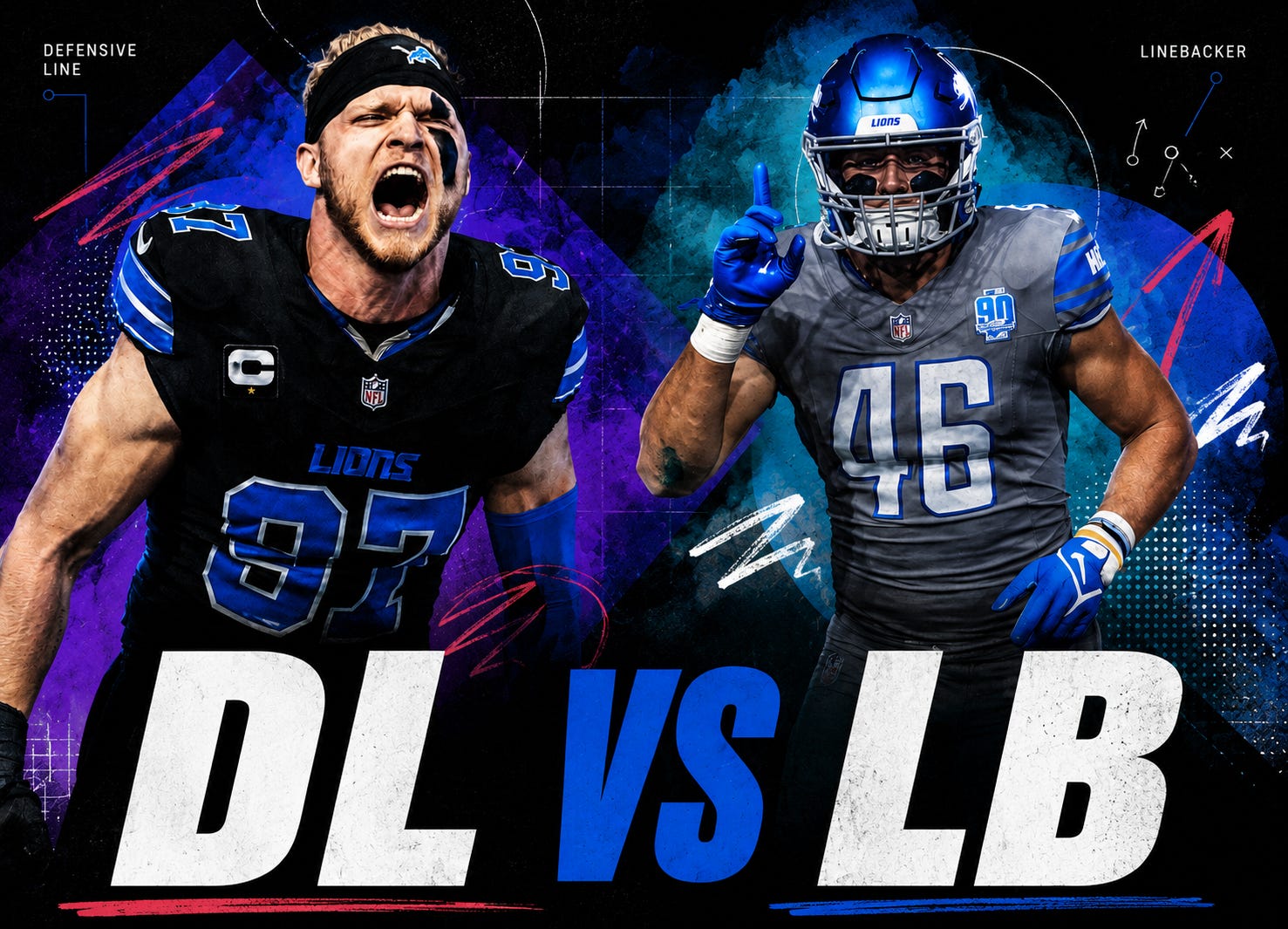
This debate comes up in the group chat every single draft season. No, not if Joe Dimmagio is a dunker, or if soup is a meal. If you’re picking early in your IDP portion, do you take the linebacker or the defensive lineman?
I don’t think there’s a true consensus, and I give side-eye to anyone who gives you one without asking a follow-up question first. It really comes down to two things you can check before you ever sit down at your draft: your scoring settings and your roster construction. Once you lock those in, honestly, the DL-vs-LB call mostly makes itself.
Start with the LB position
As NWA cautiously warned, don’t get high on your own supply. But in this case, I’ll make the exception for the linebacker position. In most scoring systems, there’s nothing inherently wrong with going linebacker early. Shocker. The linebacker guy recommends going LB early.
As I mentioned in my previous article, there are only 32 true three-down LBs and 36 played in over 900 snaps.
The deeper your league and starting requirements, the LB pipeline diminishes
I don’t think the defensive line has that problem, and it’s not because DL talent is deeper than LB talent. A pass rusher doesn’t need three-down volume to matter for you. A rotational edge playing half the defensive snaps can still get you sacks, hits, and hurries in obvious passing downs, because his value comes from opportunity concentrated in a handful of situations, not from being out there for every snap. The floor might be lower, but that ceiling is higher than the roof. Thanks for that, MJ. You can find a startable defensive lineman in the late rounds. Look at Nick Herbig. He finished as the DL29 in overall scoring and played just 60% of the snaps.
The same can’t be said for a linebacker. In those later rounds, you’re hoping that linebacker with a 70% snap share is highly efficient.
I think that scarcity gap is real no matter what league you’re in. What actually changes the answer is everything below.
Check your scoring first. Here’s the actual data
Tackle-heavy scoring (2 pts/solo, 1 pt/assist, 3 pts per half-sack, 2 pts/TFL) rewards volume above everything else. Big-3 scoring (5 pts/sack, 6 pts/INT, 1.25 solo/0.75 assist, plus QB hits and TFLs) leans hard into the big plays; the high-variance ones. I ran the actual 2025 season through both formats to see if “does scoring matter” has a real answer, and it does; just not as much as you’d think, and not where you’d think.
Top 15 overall: Tackle-Heavy gives you 12 linebackers and 3 edge rushers. Big3 gives you 8 linebackers, 6 edge rushers, and a DT. That’s the widest gap in the whole dataset. Right at the very top, splash scoring genuinely lets guys like Myles Garrett, Brian Burns, and Maxx Crosby climb over volume linebackers who’d otherwise be ranked ahead of them in a tackle-heavy build.
But by the top 30, the gap almost completely disappears. Tackle-Heavy: 19 linebackers, 8 edge rushers. Big-3: 19 linebackers, 9 edge rushers. Same linebacker count. Nearly the same edge count. Whatever edge splash scoring gave pass rushers in the top 15 basically evaporates by the time you’re drafting the back half of round two or three, because you’re comparing full-season totals at that point, and volume linebackers just catch back up on raw tackles.
Top 50 is where it splits again, and this is the part worth remembering. Tackle-Heavy: roughly 30 linebackers, 9 edge rushers, 8 safeties. Big-3: 26 linebackers, 16 edge rushers, 4 safeties. This is the actual reshaping of your board; Big-3 scoring nearly doubles how many edge rushers are worth a roster spot, because splash production alone keeps mid-tier pass rushers relevant without three-down volume. Tackle-heavy does the same thing for safeties instead, since box safeties and run-support DBs rack up enough solo tackles to matter even without takeaways.
One more thing the data made obvious: durability beats scoring format every time. T.J. Watt had the 6th-best per-game average among edge rushers in Big-3 scoring, and still finished 37th overall on the season because he missed 3 games. Micah Parsons, same deal; elite per-snap production, 30th overall finish, because he only played 14 games. This might seem obvious; splash upside means nothing if the guy isn’t playing. I know, DUH.
That’s true in both formats, but it hits pass rushers a lot harder than it hits linebackers, since LB injury profiles just tend to run lower.
So does scoring matter? Yeah, at the margins; mostly in how many mid-tier edge rushers versus safeties are worth rostering. It does not change anything at the very top of your draft. Linebackers hold 19 of the top 30 spots no matter which format you’re running. If you were hoping splash scoring gave you a green light to fade linebacker early, in the words of Bad News Barrett, I’m afraid I’ve got some bad news. The data says no.
Then check your roster slots
This is underrated.
If you’ve got more dedicated LB slots than DL slots, the scarcity argument gets stronger, not weaker. You’ve got more mouths to feed at the shallower position, so the LB run starts earlier and hits harder. Prioritize LB, don’t overthink it. Think of it this way. The LBs are the cinnamon babka. Tried and true, absolutely delicious. Defensive linemen are chocolate babka. Good in a pinch, and a decent replacement.
If you’ve got more DL slots than LB slots, you need bodies at the deeper position in greater volume; but deeper doesn’t mean worthless early. Grab your locked-in three-down linebacker(s) first for the floor, then lean on DL depth to fill the larger number of slots later, since that pool holds up quality much further into the draft.
If your build is FLEX-heavy, where DL/LB/DB are interchangeable, this is where the defensive linemen depth advantage matters most. Plug your rotational pass rushers into flex instead of dedicating a locked position to them, take your premium linebacker early, and lean on the DL pool’s depth to fill flex value later. It looks like flex construction rewards taking the scarce asset first and the deep asset second.
LBs are your floor, but their ceiling wins weeks
Whichever way your league leans, the tension underneath doesn’t change. Linebackers give you floor. Defensive linemen give you a ceiling. An elite, three-down LB gives you 8-12 tackles most weeks like clockwork, rain or shine. A rotational pass rusher gives you 2-5pts in most weeks and a 2.5-sack explosion in others. Neither one is objectively “better.” It’s about which one your league’s scoring rewards, and the risk you’re willing to take.
But when that LB ceiling week hits, there’s nothing better than watching your LB notch 9 tackles, record a sack and force the fumble for a potential 25-point week.
The IDP draft day roadmap
Pull up your scoring settings and your starting lineup requirements side by side before your next draft. If tackles carry real weight and your LB slots outnumber or match your DL slots, take the linebacker early and lean on the deeper DL pool later. If your scoring rewards splash plays and your build leans DL-heavy or flex-heavy, you’ve got more room to let the linebacker slide a round and grab pass-rush value instead. It’s like starting an offensive draft with a bell-cow RB, drafting two WRs next, then backfilling with another three-down RB.
But if you’re still on the fence after running your own settings through all this, I’ll just tell you where I land; take the linebacker. Here’s the actual case for it. Once again, shocker. The LB guy favors the linebacker. However, I think the data backs me up here.
The data above isn’t just a scoring quirk; it’s the whole argument. Linebackers hold 19 of the top 30 spots in tackle-heavy scoring and 19 of the top 30 in Big3 scoring. Same number, completely different formats. That’s not a coincidence; that’s a floor showing up twice. A three-down linebacker’s value doesn’t come from one skill that scoring can turn up or down. It comes from being on the field for every single snap, which turns into tackles no matter how your league happens to weigh them. Move the scoring dial wherever you want; the guy playing 95% of the snaps still shows up near the top.
Defensive linemen don’t get that same insurance, and in fact, their variance swings wildly. Their value lives in a handful of splash events: sacks, hits, forced fumbles, and concentrated value is fragile.
James Pearce was a fascinating case in 2025. He finished as the DL27 in Big-3 scoring, despite recording just 26 tackles. He had a strong finish to his season with sacks in 8 of the final 9 games. That tackle floor is scary, since he only played in 199 run-defense snaps.
That’s why the floor argument isn’t just a hedge for me; I think it’s the more reliable path to points across a full season. A linebacker having a “down” year still gave you 5-6 tackles a game on his worst weeks. A defensive lineman having a down year gave you nothing several weeks running, and you had zero warning it was coming.
So here’s the real instruction: use your scoring and your roster slots to figure out how LB-heavy to go, not whether to go LB-heavy at all. The floor argument holds up in every format I tested. Take the linebacker when the board gives you the shot, and treat your defensive line picks as the ceiling picks to help build up your floor.
Be sure to subscribe to The IDP Show on Apple, Spotify, or YouTube.
You can follow us on all our social media channels, including Twitter and Instagram.
