


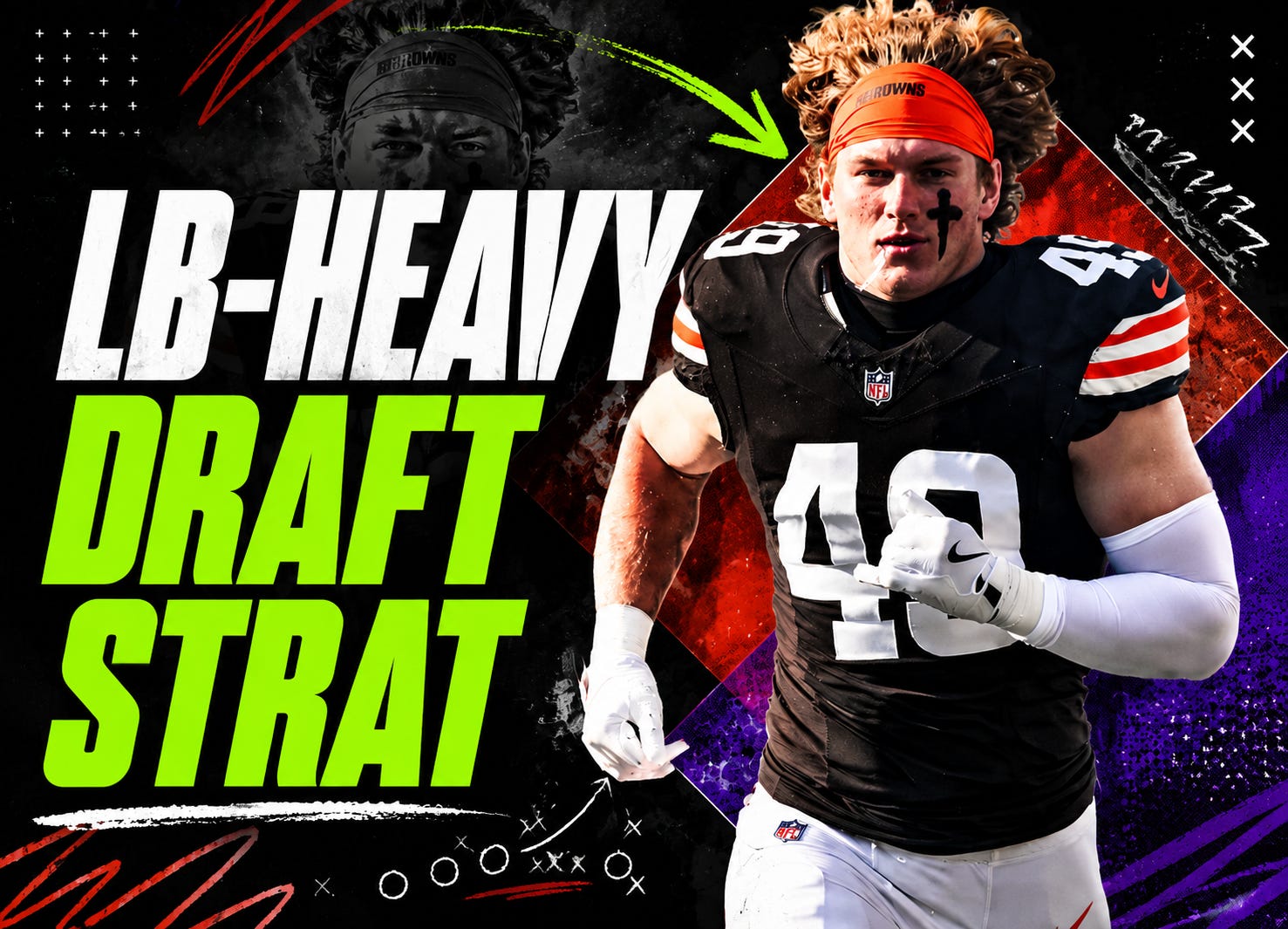
Every IDP draft season, someone tells you to wait on linebacker. Heck, I even wrote an article on going Zero-LB as a contrarian take.
Let the board come to you. Grab your DL and DBs, mop up LB value in the middle rounds.
I’m not sure if that’s the way to go, so I’m not sure I can buy into that. I tend to hoard linebackers just like they’re running backs.
Here’s why going LB-heavy from the jump might be the way to go. The numbers back it up.
The linebacker pool dries up faster than you think
There are 32 true three-down linebackers, in that they wear the green dot and are the playcallers of the defense; not factoring injuries or demotions.
In 2025, 36 linebackers cleared 900 defensive snaps. 45 (including the 36) cleared 800. By 700 snaps, you’re at 50 names, and that’s before you filter for the ones getting real defensive reps versus special-teams accumulation. It sounds like a lot until draft day.
Compare that to a 12-team league running 2-3 starting LB slots. You need 24-36 weekly-viable bodies just to fill starting lineups before anyone drafts bench depth. The pool of linebackers isn’t in your favor if you’re waiting. The moment you cross out of that 30-35 player tier, you’re drafting snap-share uncertainty, not production.
Now, if you play in a deeper league with 4-5 starting spots, if you wait, you’re counting on a lot of guys with a 70%-75% snap rate to carry your team. You might as well trust Kramerica Industries to fix the world’s oil problems.
I don’t think this is a scarcity argument. It’s the direct consequence of how the position is built. The three-down MIKE is a constant. He stays on the field regardless of personnel grouping. But that LB2/LB3 spot next to him, the SAM or WILL who gets replaced by a nickel corner in sub-packages, is your variable in the equation. Most rosters only carry two or three linebackers every single week. Draft past that tier, and you’re not getting a discount; you’re hoping that the linebacker has a full-time snap rate (which I consider 80% or higher).
Full-time linebackers come off the board in bunches
Watch any live IDP draft, and you’ll see it; the run doesn’t trickle, it cascades. Next thing you know, the entire pool of safe floor linebackers is Thanos snapped away. One league-mate takes a locked-in three-down guy, and three picks later, four more are gone. I think that’s the correct way to go, because everyone at the table knows the tier is thin. If you’re not the one initiating that run, you’re the one left holding a committee linebacker with a real snap-share question mark by Week 1.
Waiting on LB means betting that the board slows down for you. In my experience, it never has.
The edge rusher pool is a bit deeper
This is the half of the argument people miss. Productive edge rushers don’t need three-down volume to hit for IDP value. A rotational pass rusher playing 60%-65% of snaps can still put up 8-10 sacks and provide a standalone weekly ceiling off pure pass-rush opportunity. That skill set survives a part-time role in a way linebacker production simply doesn’t.
You can find your EDGE2, EDGE3, even a low-end EDGE1, in rounds where the LB cupboard is already bare. The DL well doesn’t run dry at the same rate. The 10+ sack guys might go early, but you can find linemen who provide tackles and sacks in the middle rounds.
That asymmetry is the whole strategy. Spend your premium linebacker capital early, because it evaporates fast, and backfill your defensive line later. Like Moneyball, you can build out a solid EDGE/DL group in the aggregate because your LB floor has been created.
LBs are your floor, not your ceiling
There’s a bear case here, and it’s worth confronting directly: linebackers are volume-driven, tackle-accumulation assets. They don’t have the boom weeks a pass rusher or ballhawk safety can produce off one sack or one pick-six. Fair. But that’s exactly the point of taking them early.
A locked-in three-down LB gives you a weekly floor few other IDP assets can match; 8-12 tackles/gm as a baseline outcome most weeks, rain or shine, opponent or scheme notwithstanding. That floor is what wins you the weeks your DL and DB spots go cold. You’re not drafting linebackers for the ceiling weeks; you’re drafting them so your lineup has a foundation that doesn’t collapse when the pass-rush lottery doesn’t hit.
Breaking down the floor numbers
Look at the 36 linebackers who cleared 900 snaps in 2025. As a group, they averaged 128 combined tackles on the season; right around 7-7.5 a game across a full slate. When you’re drafting for snap-share, you aren’t hunting for an outlier; you’re buying that baseline production.
Now look at the floor of the floor. Even the lowest tackle producers inside that elite snap tier, Alex Anzalone, Dee Winters, or Daiyan Henley, still averaged somewhere in the 5.5-6 tackle range per game. Even in a “down” year for a three-down player, that’s a usable, startable IDP asset. Compare that to a bad week for a rotational pass rusher; zero pressures, zero sacks, maybe a tackle or two, and a box score that’s a complete blank. The linebacker position provides a cushion that holds even for the worst performers in the tier, whereas other positions can leave you with nothing.
Consistency over splash plays in season-long formats
Sacks and interceptions are low-frequency events; they are volatile and stats you can’t rely on over a weekly basis. There’s too much variance in the position. An edge rusher can vanish for three weeks because the splash-play opportunity simply didn’t manifest. Tackles don’t work that way. Every offensive snap is a potential tackle, and a three-down MIKE is on the field for every single one.
Success in season-long IDP comes from avoiding those “zero weeks” over a 17-game stretch. A linebacker’s tackle volume is your insurance policy. A rotational pass rusher might have a higher ceiling, but their floor is literally zero.
Myles Garrett, the Defensive Player of the Year and single-season sack record holder, had just 5 games of fewer than 10 fantasy points. Unfortunately, 2 of them came during the fantasy playoffs.
Strategic roster construction
This is why you treat your linebackers as the basement and floor. Use DL/DB spots to chase the ceiling. You want two or three of these workhorse assets anchoring your roster. Once that floor is secured, you can afford to take swings on high-variance edge rushers and ballhawk safeties. If you chase the ceiling without the floor, a cold week from your DLs is a disaster. If the floor is already in place, that same cold week is just a shrug.
Try not to get cute with your sleepers. Last season, I drafted Carson Schwesinger and Jack Campbell as my first two LBs. My 3rd was Jack Sanborn. I was firm in my conviction that he was going to wear the dot, and, well, we know what happened. Back to my point, I passed on Quay Walker, Tyrel Dodson, Demario Davis, and Tremaine Edmunds. Known commodities who had established roles. Luckily, I played the wire and ended up winning that league.
The draft instruction
Prioritize your three-down linebackers in the first three-to-four rounds of your IDP-specific draft segment and in mixed drafts, three LBs in rounds 8-12. Follow the tiers, don’t get cute, and target the names you have zero doubt will see 90%+ of defensive snaps regardless of package; your green dot linebackers and not the ones who split time in nickel and dime. Once that top tier of roughly 30-35 players is gone, pivot hard to edge rushers and DBs, where the pool stays productive much deeper into the draft.
Don’t wait on your linebackers. The board won’t wait for you.
Be sure to subscribe to The IDP Show on Apple, Spotify, or YouTube.
You can follow us on all our social media channels, including Twitter and Instagram.

Shhhh, don't tell my league mates.