



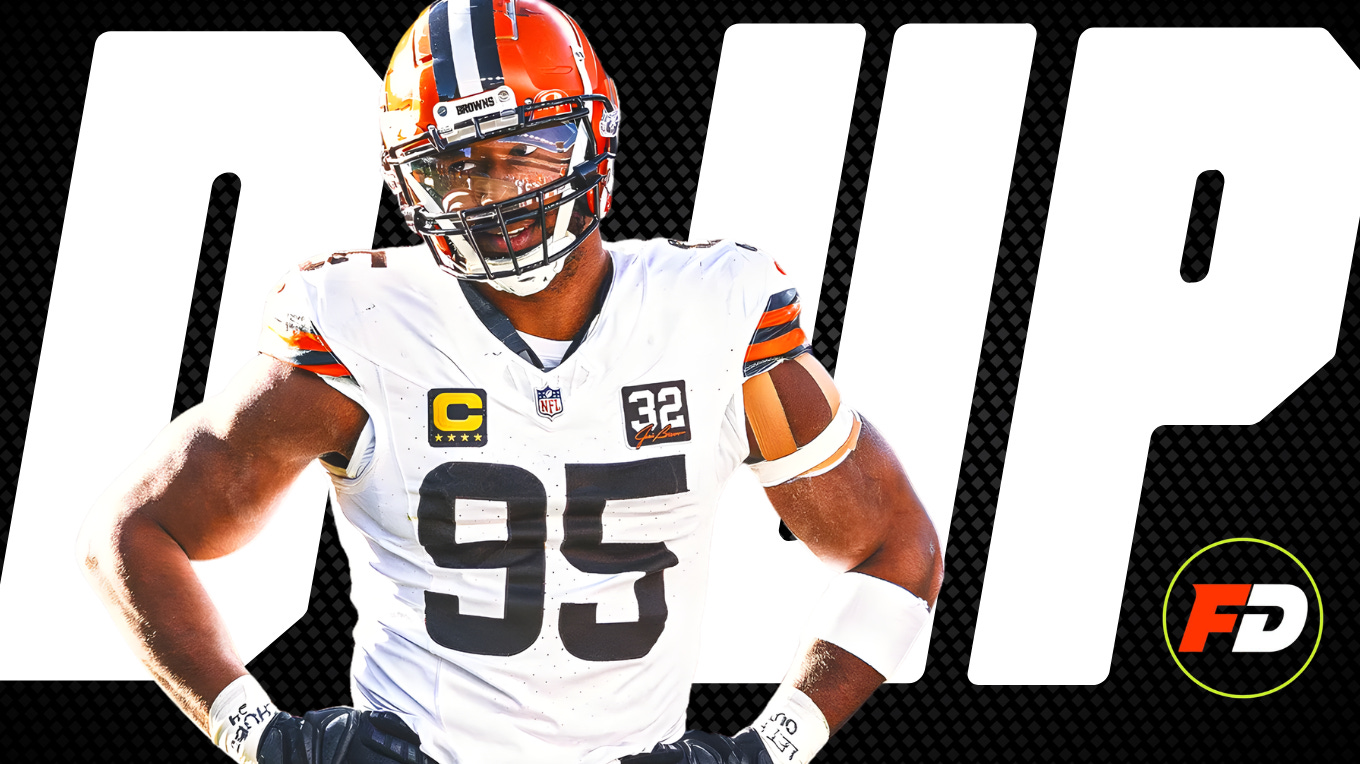
As the offseason officially begins to ramp up, it’s time to reflect on one of the most exciting developments in IDP fantasy football this past year: the D-UP contest by FastDraft. The first large-scale IDP-only best ball competition in history, D-UP gave IDP enthusiasts a dedicated, high-stakes arena to test their defensive knowledge.
On a recent episode of The IDP After Show, we broke down the data, discussed what worked, what didn’t, and how to approach Year 2. Now we’re sharing the lessons we learned here as an article. Let’s dive in.
Lesson #1: Success Came Down to the First 2 Picks
Perhaps the most striking data point from Year 1: roughly 75% of the variance in total points scored across D-UP teams came down to the first two picks. This was especially true among the top 20 finishers—those who cashed out at $100 or more. If you nailed your first two selections, the rest of the draft was almost a formality.
The single most dominant combination was Myles Garrett paired with Brian Burns. Seven of the top 20 finishers had that exact pairing. Other high-performing duos included Maxx Crosby with Brian Burns, Aidan Hutchinson with Brian Burns, and Myles Garrett with Andrew Van Ginkel. The common thread? Elite pass rushers in both early picks, with Burns in particular proving to be exceptional value given his second-round ADP in a 10-team format.
Lesson #2: DL/DL Roster Construction Dominated
The data was clear when it came to how top rosters were built. Teams that opened with two defensive linemen (DL/DL) averaged approximately 1,350 total points, and 18 of the top 20 finishers used that exact construction. By contrast, DL/LB builds averaged around 1,293 points, and LB/LB builds dropped further to 1,236, nearly 115 points behind the leading approach, with zero top-20 finishes.
As for defensive backs: 15 of the top 20 rosters had zero DBs, and five had just one. No top finisher carried two or more. Taking a DB in the first three rounds was associated with a drop of nearly 23 points in mean scoring. While DBs like Brian Branch could have been a top-five performer in a 2024 iteration of D-UP, the 2025 results suggest patience is warranted when it comes to the position.
Lesson #3: 2025 May Be an Anomaly, So Don’t Overreact
While the data strongly favors edge rushers, it’s worth keeping the broader context in mind. The 2025 season featured an unusually concentrated top end: only 26 players crossed the 200-point threshold, compared to 35 who would have done so if the contest had run in 2024. The average of the top five D-UP scorers was 278 points in 2025 versus 253 in 2024, a 25-point gap reflecting just how dominant the elite tier was.
Myles Garrett had a historically dominant season, outscoring any individual player from 2024 by over 50 points in D-UP scoring. Three of the top five D-UP performances across both seasons came from 2025 alone. This kind of top-heaviness is not the norm, and we’d suggest caution against building an entire 2026 strategy around what worked in 2025.
Lesson #4: Draft Slot Matters (Pick 4 Was the Sweet Spot)
Because D-UP in 2025 was a 10-team, six-round format, your draft slot has an outsized effect on roster construction. Slot 4 was the most productive position in 2025, producing 10 of the top 20 finishers. This aligns directly with Myles Garrett’s average ADP of 3.78. The pick-four slot was essentially purpose-built to land the top overall player. Slot 3 added three more top-20 finishers, meaning 13 of the 20 cashing teams came from just those two draft positions.
On the other end of the spectrum, slot 10 produced zero top-10 finishers. The snake format’s back-to-back pick advantage at the turn didn’t compensate for the inability to land one of the truly elite pass rushers with an early selection. Again, this is largely a function of how top-heavy 2025 was—but it’s a meaningful data point heading into 2026.
Lesson #5: Youth is a Trap
Despite making up roughly 30% of NFL starting defensive rosters, rookies and sophomores accounted for only six of the top 60 D-UP scorers in 2025, just 10% of the viable fantasy pool. The same pattern held in a 2024 retroactive analysis, where only five rookies or sophomores cracked that threshold.
The few who did make the top 60 came in largely at the back end of the rankings. Carson Schwesinger finished 18th, Laiatu Latu was 33rd, Cooper DeJean (a sophomore) was 36th, and Jared Verse was 53rd. Even Abdul Carter—who carried the highest D-UP ADP among rookies at 28 overall—finished 286th. That’s not necessarily a bust designation for his NFL career, but it illustrates the structural challenge rookies face (particularly in a small, six-pick format).
In a format where only four of your six players score each week and there’s no way to adjust your lineup, floor matters enormously. Rookies are eased into rotations, sophomores are inconsistent, and the small roster amplifies every miss. Veteran players who carry volatility—a pass rusher known for a big game here and there before going quiet—are still preferable to rookies, because at least the nature of that risk is understood. With a rookie, you’re not just accepting uncertainty; you’re accepting a complete unknown. In a format this compressed, knowing what kind of risk you’re taking is itself a form of edge.
Final Takeaways
Year 1 of D-UP delivered on its promise as a compelling, IDP-focused best ball contest. The data tells a coherent story: prioritize elite edge rushers early, build DL-heavy, exercise patience with defensive backs, and avoid the temptation of exciting rookies in a format that punishes volatility.
At the same time, don’t over-index on a single year that featured historically dominant performances and an unusually high injury rate among top-tier players. The best D-UP drafters in 2026 will use 2025’s lessons as one data point among many, not as an immovable blueprint.
Be sure to subscribe to The IDP Show on Apple, Spotify, or YouTube