


Trades, waivers, and rookie drafts are the three legs of roster construction in dynasty, and rookie picks bring the highest amount of variance. Dynasty managers spend a much higher percentage of time on rookie draft preparation than on the other two legs, but it is simply hard to know how prospects will perform at the highest level, for different coaching staffs, and in various schemes.
Given the value of roster spots on your dynasty squads, you must keep tabs on your rookies to know whether they’re worthy of continued investment at the trade-off of waiver wire additions. It’s a gamble to give up on rookies during their rookie season, but you can essentially double down on losing by bypassing an upside waiver play because you can’t bring yourself to move on from a bad rookie pick.
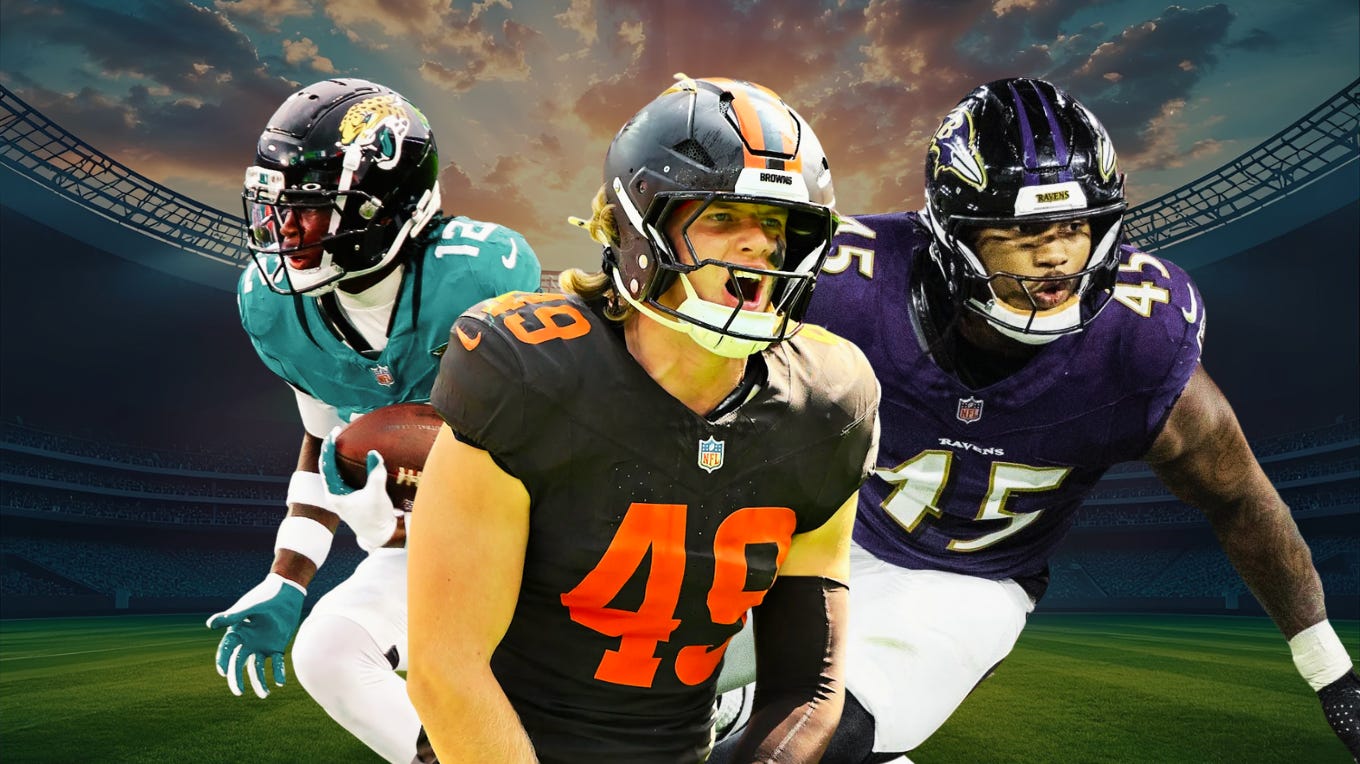
In this, the second in a two-part series, Jason King and I check in on how rookie IDPs are performing and how we value them for dynasty based on current performance and outlook. Part one focused on the NFC, and here, we analyze the AFC.
Options for All 12-Team Dynasty Formats
I’m considering this category to include rookies rosterable in dynasty setups that combine defensive linemen and defensive backs, with as few as two DLs, three linebackers, and two DBs.
1. Carson Schwesinger, LB, CLE
The NFC may have the numbers advantage, but the AFC has the best player on either list, and it’s this man right here, Carson Schwesinger, the favorite to win the Defensive Rookie of the Year award. He’s been the gold standard among not only rookie linebackers, but all first-year defensive players, ticking every box we look for. He impressed throughout training camp, earned a full-time role from the start, and although Jordan Hicks’ July retirement opened a path, the former Bruin was trending toward a major role regardless.
The 22-year-old sits in the 56th percentile among all linebackers for tackling efficiency at 13.2%, trailing fellow rookies Barrett Carter, Shemar James, and Teddye Buchanan in that regard. But he’s rapidly closing the gap, posting double-digit tackles in each of his last two games. And based on the quality of his play, he and Jihaad Campbell—assuming Nakobe Dean departs in free agency—profile as the only linebackers in the 2025 NFL Draft class that we can fully trust to remain solid contributors for years to come.
We knew he had the elite range and instincts beyond his years. When we consider how well he has put both to such effective use so far, and couple that with the knowledge that he only had one season as a starter in college, Schwesinger’s ceiling is absurdly high.
2. Travis Hunter, CB/WR, JAC
Here he is. The wildcard nobody could pin down at the start of the season, and still the uber-talented wildcard we don’t really know where to rank in IDP, partly because the Jaguars haven’t entirely made up our minds for us, and partly because some IDP leagues don’t reward offensive points.
While Travis Hunter was definitely trending more toward a greater role on offense than he was on defense before the injury prematurely ended his season, he remains firmly on the dynasty IDP radar as a player who can, in certain formats, score huge points for dynasty managers.
Simply put, for those in leagues who do benefit from offensive scoring, he’s the only player who can challenge Schwesinger for the No.1 spot. For everyone else, drop him into the category below, and maybe even further.
“Five Position” League Options
All below should, in my opinion, be rostered in any 12-team dynasty league with five positions, and certainly any requiring 11 defensive starters (two defensive ends, one defensive tackle, two linebackers, two safeties, two corners, and two flex, for example).
3. Mason Graham, DT, CLE
As the fifth overall pick in the draft, it was assumed Mason Graham would feature heavily, but for the rookie to lead the Browns’ DTs in snaps in almost every game, while playing alongside such a proven and capable player as Maliek Collins, speaks volumes about the level of trust Jim Schwartz has in the youngster.
DT is a famously hard position to master in year one, so we won’t read too much into Graham’s 35th percentile tackle rate, modest 10.7% win rate, or single sack. We will, however, touch on his 8.7% pressure rate, which, while already ranking among the best rookie IDLs in 2025, looks even better when we focus on his recent games. Over the last three contests, that figure increases to an impressive 16.4%.
Considering he has been double-teamed at a rate of 55% in 2025, these figures are encouraging, especially when we know he has the first step, power, relentless motor, AND draft capital to become a fantasy mainstay. Were it not already obvious, Graham should be prioritized in DT-required leagues.
4. Teddye Buchanan, LB BAL
It’s a real reflection of how shallow the AFC pool of rookies is that Teddye Buchanan is ranked this highly. It only took two weeks for him to usurp Trenton Simpson, but Simpson was never going to be a major obstacle.
I should be careful in my assessment because it’s easy to judge rookies too hastily, especially linebackers, but what I see in the NFL version of Buchanan is very close to what I thought of him in college. He’s a sound tackler who diagnoses plays more quickly and reliably than most rookie linebackers, with better-than-average athleticism at the position. But every time I watch him play, he comes up a little short in coverage, despite the fact that his PFF grades suggest he has what it takes to improve in that area.
There are other weaknesses to his game, such as an inability to get off blockers, but I’m far more concerned about the previous point. Can he prove me wrong? Sure. And by ranking him at four, I’m clearly leaving room for him to progress in that regard.
5. Barrett Carter, LB CIN
Barrett Carter will have much bigger fans in the IDP community than me. It’s hardly a reach to suggest the youngster has commanded such a big role simply because Logan Wilson was already on the outs and Demetrius Knight Jr. was performing far below even modest expectations.
Yes, his 15.5% tackle rate, which ranks in the 91st percentile among all linebackers and first among rookies, is precisely what we need from our fantasy linebackers, but from a dynasty perspective, we must also consider whether he’ll retain a heavy workload as a full-time starter for years to come.
In that sense, I have serious concerns about Carter’s performance so far. Against the run, his diminutive stature means he gets caught up in traffic. In space, and despite his excellent athleticism, he often looks a little lost.
It’s still very early, of course, and not every linebacker can come out firing like Schwesinger. With that in mind, I’ll give the rookie a partial pass because Al Golden seems intent on letting Carter learn on the job. There’s no better way to learn than on the job.
6. Demetrius Knight Jr., LB CIN
In 2024 with the Gamecocks, Knight exhibited many of the traits we desire in someone who we believe can, relatively quickly, become a fantasy asset. He performed well in most areas, showcased his athleticism at the Combine (vert aside), and the draft capital and soft landing spot in Cincy virtually assured him of a quicker path to snaps than several of his peers.
The results have not been kind. If Carter’s play has been sub-par, Knight’s has been abysmal, as he’s underperformed in almost every conceivable way that we can measure a player’s performance, ultimately leading to him conceding ground to his rookie cohort.
While the early signs have been alarming, we would do well to remember the harsh lesson we have learned in previous years: rookie linebackers often look pretty crappy in year one. Cedric Gray is the best recent example of the leap such players can make from one year to the next, and few considered him to have the potential of Knight as a rookie. Even those who did, such as Jack Campbell and Devin Lloyd, struggled mightily in their debut seasons.
7. Mike Green, EDGE, BAL
Injuries to Kyle Van Noy and Tavius Robinson, the ineffectiveness of David Ojabo, and the Odafe Oweh trade have led to Mike Green playing a larger role than Zach Orr likely had in mind for the rookie. We’re beginning to see some positive signs with 2.5 sacks in his last five games, but his pressure rate still languishes at 7.1%, and his 13.7% win rate doesn’t impress either.
So, why is he ranked this highly? Four reasons.
Firstly, I believe in his talent. He was my third-ranked edge in the draft class, owing to his 17.3% pressure rate, which was third best among all rookies, and his 28.9% win rate, which ranked sixth among 200 edges.
Secondly, by persevering with Green and giving him such a large snap share, Orr has shown he clearly believes in the youngster’s talent. The Ravens’ DC recently stated: “He comes out here every day, busts his tail off, you’re starting to see his production to start to go up and his ability to really start showing.” Coach speak? Perhaps. But it’s showing up in small ways, not least how heavily involved Green has been.
It also helps Green’s outlook that both Van Noy and Ojabo are scheduled to become free agents in 2025. Clearly, they’ll either bring one of those players back or dip into free agency or the draft to add extra bodies, but after investing a second-round pick in Green, despite his off-field concerns, they must believe in his future as an impact player.
And finally, while it’s less compelling than the other reasons because of the tiny sample size, his two most disruptive games have come in his last three outings. Without getting carried away, this point, along with the others, hints at the progress I believed would occur.
Medium-Size League Options
I’d consider the below to be rosterable in all 14-team leagues that utilize at least two starters at both safety and corner, and a stand-alone defensive tackle with some DT-premium scoring settings.
8. Derrick Harmon, DT, PIT
Derrick Harmon, like Green above, has done very little so far. He has remained third in the Steelers’ four-man rotation on the defensive interior much of the season, falling in behind Cameron Heyward and Keeanu Benton. And, while he ranks second in that group in sacks, his 7.5% win rate ranks far below the mark set by the others.
With Heyward and Benton under contract through 2026, it likely takes an injury for Harmon to find his way onto the field enough to become a viable fantasy starter. However, I remain as bullish on him as I was pre-draft, because his explosive first-step and impressive 16.8% pressure rate in 2024—which ranked in the 97th percentile among all draft-eligible DTs—suggest he has what it takes to stick at the NFL level.
9. Shemar Stewart, EDGE, CIN
Everyone was aware the Bengals took Shemar Stewart as early as they did because of his otherworldly combination of size and athleticism, and not because of his lacklustre college production and supporting metrics. Even Stewarts’ biggest fans knew he probably wasn’t going to hit the ground running.
It’s a crying shame that he hasn’t been healthy enough to maximise his development opportunity, but for that reason, if you were a believer in his long-term outlook before, you should remain so now.
Personally, I view RAS scores as a complement rather than a major needle-mover. I think most of us feel similarly. I’m too haunted by the ghost of Myles Murphy, Solomon Thomas, and Co. to invest as heavily as is needed to acquire Stewart in dynasty. But I’ve also got one eye on what will likely be a mediocre-at-best Bengals’ edge group minus Trey Hendrickson in 2026, and with the draft capital Stewart attracted and the time missed this year, I know he’ll be given a long runway.
10. J.T. Tuimoloau, EDGE IND
At this point, it may feel like we’re scraping the bottom of the barrel already, and compared to the rookies in the NFC, we are. However, there’s plenty to like about J.T. Tuimoloau as a player and his outlook beyond this season.
The 22-year-old was disruptive in his final two or three years at college, but it wasn’t until 2024 that his impact began to pay dividends. And when he hit, he really hit, especially during the playoffs, where his explosiveness and technique helped him to 6.5 sacks and Ohio State to a national title.
He’s been pretty quiet in his rookie season, often the fourth or fifth choice in the Colts’ five-man rotation, but with Samson Ebukam and Kwity Paye set to become unrestricted free agents in 2026, Tuimoloau should get his chances. Hopefully, he capitalizes.
11. Kenneth Grant, DT, MIA
Kenneth Grant’s ceiling as a pass rusher may be lower than that of other DTs in the 2025 class, but in time, he could become the elite run stuffer he was for Michigan. Assuming that happens, he could well become a solid fantasy starter in fantasy leagues where the scoring format owes itself more heavily toward tackles than sacks.
The trouble is, Zach Sieler signed a big extension this year, and although the veteran’s sudden drop-off in production makes him less of an obstacle than he would have been in previous years, the way Sieler’s deal was structured, he’s almost certainly going to remain a significant roadblock through 2026.
So, unless Grant can surpass my expectations as a pass rusher, or find a way to earn more than the ~50% snap share he’s currently getting, it’s hard to see him become an upper-tier performer at DT in the immediate future. A Grover Stewart-like career would be nice, but it’s too early to tell if that’s even remotely realistic.
12. Kevin Winston, S, TEN
Kevin Winston has come on strongly in the absence of Xavier Woods. He may lose the role once Woods returns, but the rookie has taken advantage of the small window to show that he’s not only fully recovered from the ACL, but that he has what it takes to handle a starting role.
Woods is under contract through 2026 and is affordable to keep on, but on a team such as the Titans, with such a steep hill to climb before they become competitive, it’s entirely possible Tennessee goes with the youth movement. With his profile as a box safety, it’s well within Winston’s range of outcomes to become a solid IDP contributor.
Deep League Options Only
The corners listed here are streamable in most dynasty formats that require two cornerback starters. Otherwise, I’d consider everyone below to be considerations in leagues with 16 teams or more, with 60-70 available roster spots (including taxi squads).
13. Omarr Norman-Lott, DT, KC
Omarr Norman-Lott’s college highlights are as impressive as any rookie DT, where his explosiveness, active hands, and relentless energy make him an absolute nuisance at times. Dig a little deeper, and it’s apparent that his pad level and baffling tendency to disappear for long stretches make him among the more maddening prospects to project, let alone rank among other AFC rookies.
At this point, and while his modest ranking may suggest otherwise, the swing is worth the gamble in the hope that Norman-Lott realises his potential.
14. Ashton Gillotte, EDGE, KC
There are not many players in the “deep league” category who can boast the kind of progression, especially as a pass rusher, that Gillotte enjoyed throughout his college career. He wasn’t a one-trick pony, either, proving stout against the run, where his power is clear to see, and his motor ran non-stop.
Any concerns that the Chiefs may view him as an interior rusher have been put aside, for now at least. Hopefully, in time, he can also alleviate worries that he’s been so ineffective so far, despite, at times, pushing Charles Omenihu for the second edge role alongside George Karlaftis.
15. Jack Kiser, LB, JAC
Jack Kiser may be the ultimate dart-throw of the article. He’s the player who, behind perhaps only Hunter, and possibly Norman-Lott, I had the most trouble deciding where to rank. Ask one of the elite IDP fantasy minds, such as Jon Macri, and they’ll point to his incredible college PFF grades across the board and elite red zone efficiency. And who am I to argue? But ask someone else, and they’ll point out his inability to get off blockers, limited wingspan, and age (Kiser is 25).
If this year is any indication, and assuming the Jaguars don’t add any additional competition, Ventrell Miller appears to have the inside track on inheriting a larger role IF Devin Lloyd walks in 2026. But Miller really hasn’t done anything at all to show he deserves it.
16. Malaki Starks, S, BAL
Pre-drafted, I was willing to ignore Malaki Starks’ poor athletic testing and became somewhat enamored with his game-changing abilities as a sound tackling, do-it-all safety capable of filling most roles for whatever team drafted him. Sadly, from a fantasy perspective, his landing spot with the Ravens meant he would play the role he was always better suited for, aligned deep, with Kyle Hamilton taking on the greater percentage of snaps nearer the line of scrimmage.
17. Jack Sawyer, EDGE, PIT
To my eye, there was little to choose between Jack Sawyer and Tuimoloau in college, who both delivered impressive year-on-year improvement before reaching their apex in 2024. But I concede to the knowledge of NFL teams, who believed two clear draft rounds separated the pair. That factors into their ranking here.
Also a consideration is the disparity between the medium-term outlook of the duo. Sawyer not only has Watt and Highsmith ahead of him, but a ready-made replacement in Herbig should Highsmith’s injury concerns tempt the Steelers into parting ways. Conversely, as stated above, Tuimoloau has a path to snaps as early as 2026.
18. Landon Jackson, EDGE, BUF
Landon Jackson has the size and athleticism we crave in our edge rushers, and the third-round draft capital invested in him suggests he can at least become a rotational player, especially if A.J. Epenesa and Joey Bosa move on in 2026. However, I believe his lack of bend limits his upside as a high-end pass rusher.
19. Jahdae Barron, CB, DEN
Jahdae Barron was in my top tier of corners in the rookie class, as much for his talent as for the opportunity to play across from Patrick Surtain. In 2024, we noticed that Surtain’s presence meant that Riley Moss and Ja’Quan McMillian benefited from a heavy ratio of passes thrown their way relative to the amount of coverage snaps they had played. While that ratio has dropped off in 2025, I still think Barron will emerge as a viable fantasy streamer when his role increases. And it will in 2026.
20. Deone Walker, DT, BUF
Deone Walker has taken advantage of injuries to Ed Oliver, DaQuan Jones, and T.J. Sanders and put together a season where he’s flashed some real standout moments on the interior of the Bills defensive line. At 6’7” and 331 pounds, his size is always going to be a mismatch, and he uses his gargantuan stature and huge wingspan to disengage and create distance from would-be blockers.
If he builds on this season, if he becomes more consistent, and if Jones moves on in free agency, there’s a world in which he becomes a startable fantasy option. But that’s a lot of ifs.
21. T.J. Sanders, DT, BUF
T.J. Sanders should probably be above Walker given his second-round pedigree. He was playing slightly ahead of his teammate at the start of the year, and despite not doing a great deal, the power that led the Bills to invest so heavily in him was apparent.
I’m a little lower on Sanders than many. I just don’t see the consistent get-off that I want in a fantasy DT. With that said, it would not surprise if he supplanted Walker and put up solid tackle volume behind Oliver in the rotation come 2026.
22. Sai’vion Jones, DT/DE, DEN
We haven’t seen it yet, but Sai’vion Jones’ position versatility is a great fit for Denver’s scheme, where players like Zach Allen and John Franklin-Meyers have truly excelled. The Broncos’ elite defense and smothering secondary are a boon for every defensive lineman, even for guys like Franklin-Meyers who struggle to play even half the available defensive snaps each week.
Franklin-Meyers is set to become a free agent next year. It must be tempting to bring him back, but after spending a third rounder on Jones and considering how impressive the youngster looked for the Tigers in 2024, it seems likely that the 22-year-old will step into a larger role next year. If that happens, let’s hope the effort level, toughness, and high floor as a run defender, so evident in 2024, translate.
Be sure to subscribe to The IDP Show on Apple, Spotify, or YouTube.
