


As we head into the dynasty offseason, you may look at your end-of-season rosters and see some holes that need filling, or rosters that need total rebuilds. Early offseason is a good time to look back at 2025 and think about what worked, what didn’t, what your team looks like going forward, and what you might want to change in 2026.
Before we get bombarded with rookie content, I thought it would be a good exercise to go through my five dynasty IDP teams to see how each team was built, as well as when and how each player was acquired. Each league has a different number of teams, starting requirements, roster sizes, and rules, and as I go through, I’ll share my thoughts on how each format is a little different and how I prioritize different positions between each league. I’ll also add in some of my core roster-building principles across all of my teams.
By no means is this meant to be a brag post about my dynasty rosters because there are some terrible, terrible decisions that have been made with these teams, but I still think it’s informative to see how much each team is built by rookie draft picks or waivers and when those waiver claims are made. I will warn that I’m not a big trader, though; no one will mistake these teams for Bobby Reynolds’ dynasty teams.
This is an exercise that anyone reading this should do with their teams to see if they over- or under-emphasize taking IDPs in rookie drafts, as well as looking at the league-to-league differences that affect those decisions.
Football Premier League Championship (MFL)
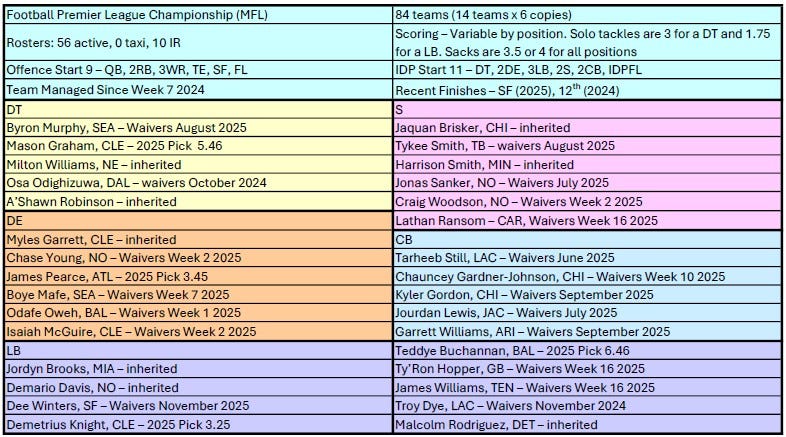
The first thing you will notice with this team is how much it has been turned over since I inherited it in the middle of 2024, with only 7 players remaining from that time. I thought it was one of the worst IDP rosters in the league in 2024, but by the end of 2025, I think it’s gotten to a point where the roster is above average at all IDP positions except CB.
Some luck was involved in that by inheriting the 2025 DE1 (Myles Garrett) and LB1 (Jordyn Brooks), but a lot of other moves were made along the way. This team also got several gifts on waivers, with Tykee Smith, Byron Murphy II, and Chase Young all being dropped by other teams before becoming regular starters on my team.
This team came to me with 10 DTs but just 3 DEs on the roster, which is a totally insane ratio for a league starting 1 DT and 2 DEs. Even now, rostering 5 DTs is too many for this team, but at the start of the season, there were a lot more unknowns than there are now. Milton Williams was on a new team with a big contract, but we really didn’t know what his playing time would look like. Murphy had a mediocre rookie season, was dropped by another team in the offseason, and quickly picked up. Mason Graham was snapped up very late in the rookie draft solely because he was a top 5 pick still available in round 5. From a redraft rankings point of view, this team had a bunch of DT2s at the start of the year, and the hope was that one or two would outperform.
The second DE spot was more or less unsolved until Young was dropped to waivers mid-season. Between him and James Pearce Jr.’s late-season emergence, it’s a much stronger position group and has several options to play depending on matchups.
In 2024, this team had just two startable LBs. There was a speculative Dee Winters add at the end of the year, and draft picks spent on Demetrius Knight Jr. and Teddye Buchanan. All three ended up in my lineup at one point or another this year, which is a very fortunate outcome for all of them to end up being useful. Ty’Ron Hopper is this team’s speculative add going into free agency.
Similar to the other positions, just 2 safeties and none of the CBs on the roster were on the team in 2024. Garrett Williams was one of the players who got ideal CB usage right from the start of the year (full-time but mostly playing slot CB). He ended up being too injured to benefit this team. What’s not shown here is how many players were cycled through to get to this group. Jordan Fuller, Adoree’ Jackson, Benjamin St-Juste, DJ Reed, Justin Simmons, Eric Murray, Jordan Howden, Marte Mapu, Isaiah Pola-Mao, and several other players were all added and dropped between October 2024 and now.
Premier League (Sleeper)
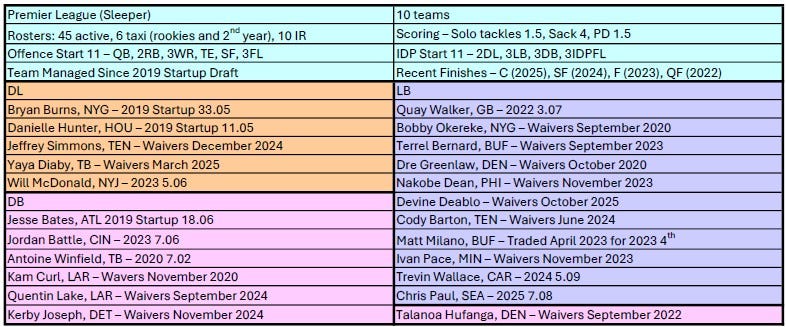
A lot of start 11 IDP leagues require 3 DL instead of 2, and with just 10 teams in the league, it doesn’t make them valuable enough to roster too many. So for this league only, I try to be price-conscious on anyone I’m adding. This hasn’t always been the case because I used pick 2.10 on Chase Young in his rookie year, and then cut him a few years later. Other than that, I have been very lucky to have been able to keep two players taken in the startup 7 years ago, so I haven’t had to chase for solutions at the position.
Defensive line being devalued has directly impacted LBs. With the ability to play 6 at once, it’s been a focus of mine to be able to do so at all times, which usually means rostering 10 or more LBs. When I went through this team, I was surprised to see that Quay Walker was the only regular contributor that I drafted (I thought I drafted Terrel Bernard).
Zooming in on the 2022 LBs, Nakobe Dean was a highly regarded prospect who slid to the third round, while Walker was projected as a high second-round pick that snuck into the first round. IDP managers mostly ignored Dean’s slide and drafted him ahead of Walker anyway. The same thing happened in this league, where Dean was picked at the 3.06, and I drafted Walker with the following pick. The Dean drafter left the league the following season, and the new manager cut Dean when he went on IR in 2023. I don’t remember if they had IR space or not, but I did and stashed Dean.
Bernard, on the other hand, wasn’t drafted in this league. Bernard spent his first year as a primary backup to Matt Milano, while Tyrel Dodson was Tremaine Edmunds’ backup. NFL teams don’t often have different backups for their starters, but the Bills did that year, and it made waivers confusing later in the year. Anyway, in 2023, there was a lot of confusion over who was going to replace Edmunds after he left for Chicago in free agency. Right before the season, the coaches announced Bernard would start, and that was that.
If any of you remember other articles I’ve written, some of you may remember when I tried to make talking about 3rd round LBs my entire identity. I won’t get into all of that now (click here if you do), but 3rd rounders being a backup as a rookie is good, and those players should probably be rostered, even in a shallower league like this (if you consider this shallow). Also, any time you are looking to draft a player who you think you might cut before the end of their second season, there are better uses of a third-round rookie pick.
This DB group has probably had the least tweaking of any team here just due to luck. Between Jessie Bates as a startup pick, Antoine Windfield Jr. and Jordan Battle as very late rookie picks, and Quentin Lake and Talanoa Hufanga from waivers, it’s been a really consistent group. This league is just the right level of depth that you can wait on Week 1 usage every year and have one or two guys you can add and be useful for the rest of the year.
Sweet 16 (Sleeper)
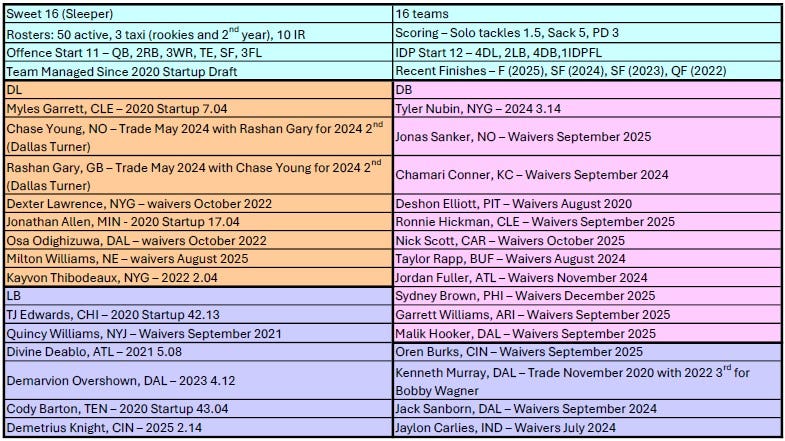
Eleven DBs is way too many DBs, and it will get cut back in the offseason. It’s a position where I’ve tried to scrape by every year because I’ve never been comfortable with my other position groups. With 50-player rosters in a 16-team league, I’ll probably never look at this roster and be happy with it. With 64 DBs, this league is also an excellent league to stream CBs based on whoever Johny the Greek puts in his streaming CB article that week.
Trading for Rashan Gary and Chase Young was a rare trade that is a win-win. I got two useful veterans, and our very own Adam Marcum spent the 2nd round pick on Dallas Turner. As is the case for DB, there’s no reason to shy away from DT, as there just aren’t enough DEs to fill out three starting spots for each team.
This league has one of the biggest mistakes in an IDP trade I’ve ever made. In November 2020, I traded away Bobby Wagner for then-rookie Kenneth Murray and a 2022 3rd (Pierre Strong). It’s a good example of how it can go very wrong when you make a trade to get younger. Since then, I’ve tried to be more mindful of how Hall of Fame-caliber players, like Wagner, can have a lot more longevity than other players at their position. I also drafted Lukas Van Ness here and cut him. You might not like Van Ness, but I wish I hadn’t done that.
You might notice that Demetrius Knight Jr. is on a lot of these teams. One of my core rookie draft principles is to target players who fall past where their draft capital suggests. Knight was often right beside Nick Martin instead of Carson Schwesinger. That probably sounds silly considering what Schwesinger did this year, but I truly believe it pays off in the long run. It’s also why I have teams that drafted Quay Walker but never Nakobe Dean.
Make IDP Great Again (Sleeper)
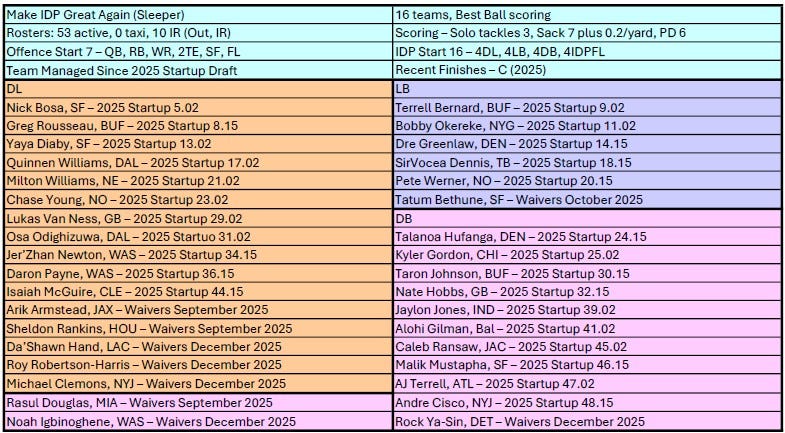
Having 16 teams and 16 IDP starters is absolutely chaotic, never mind a mandatory start 2 TE on top of it. Waivers are very bare, and most players you’ll see in waiver articles on Tuesday morning are already picked up. Those that aren’t need much heavier FAAB bids. For example, Tatum Bethune cost me 45% of FAAB (worth it).
When you are playing in a best ball league, the first thing you have to decide is whether or not you’re competitive. If you’re competitive, you need as many players who are healthy and playing significant snaps as you possibly can, because more players mean more chances for good scores in your lineup. If you aren’t competitive, you use those roster spots on developing players, if you can find any in a format this deep. In my case, I had more players on IR than I had IR space for, so some of those players had to be cut during the playoffs.
During the finals, I had the 3-sack game from Jer’Zhan Newton on Thursday night… then immediately forgot and thought I needed more DL points. So, if I had a do-over on that, I probably would not have planned for 16 DL and 13 DB, and aimed for something a little more balanced.
I tried drafting similarly to how I would in the type of best ball drafts The IDP Show runs, with heavy focus on DL early, then LB, and DB at the end. I think that worked well here, except I missed grabbing a few backup LB types. I got away with it in 2024, but I’m far too thin at LB. I didn’t even bail myself out with dual-designation players, with YaYa Diaby as my only DL/LB on the roster. That said, we know LB as a position group is lower variance week-to-week than the other positions, so it makes sense in best ball to be a little thinner.
The IDP Hunger Games: District 1 (RSO)
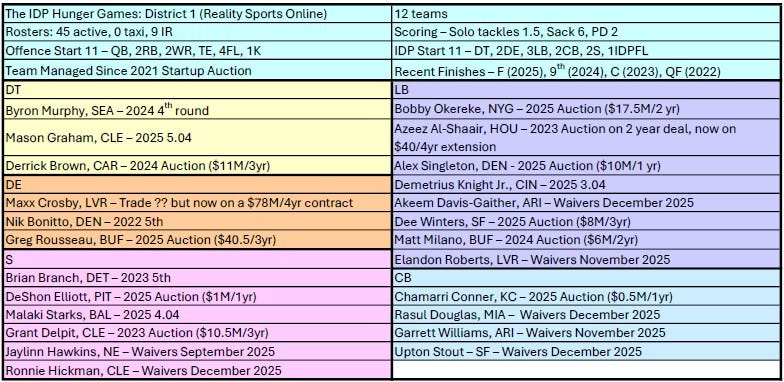
Playing in a Reality Sports Online league with partially guaranteed player contracts adds its own wrinkles. The two main ways of acquiring players in the offseason (without trading) are the rookie draft, with contracts scaled by draft pick, and the free agent auction, where every team gets a chance to bid on any player nominated, offering 1 to 4-year contracts. There are no freebies on offseason waivers by getting to someone faster than everyone else.
You still get a really good deal on pretty much any rookie contract, but if the player is bad, you’re probably cutting them early and having the rest of the dead cap advance on you for future seasons. Those rookie contracts eventually expire, and then you’re often extending a player with a contract near the top of the position group for your league, or tossing them back to the free agent pool
In the later rounds of any rookie draft, you’re often given choices between offensive rookies with Day 3 draft capital and Day 2 IDPs (or even a Round 1 DT). The IDPs have much higher hit rates than the Day 3 offensive players do, so I end up opting to spend more late draft picks on IDPs than I would in a league that doesn’t have contracts. I think this team has the most rookie draft picks on the roster, even if this league is one of the shallower ones I play in.
Veterans are locked in the offseason until your league does its auction, so scouring waivers every other day in March doesn’t help you here. In-season waivers are contracts for the current year only, after which you have to extend the player or release him back to the free agent pool for everyone to bid on.
Streaming CB is still viable here, but with the current year of a player’s contract fully guaranteed, you need to plan for it by signing cheap contracts and/or only rostering your starters in the free agent auction. Otherwise, every other position is drafted and held, or picked up in the free agent auction.
What if I Play in a League with 6-8 IDP Starters?
I no longer have any teams with 6-8 IDP starters, but my very first IDP league was a start 6, with 2 each of DL, LB, and DB. And honestly, I did a lot of that league on waivers as well. That league had contracts with an in-person auction. Where I started to run into trouble was when I left the auction with two or three great players at each position on long contracts, then taking cap hits when I would cut them the following season. A lot can change in IDP, and it’s really easy for a player to be a top 10 dynasty asset one season, then outside of the top 20 of their position the next.
I still used the odd rookie pick on an IDP. I took Aidan Hutchinson in the 4th round in one of the last seasons of the league, but I did it much more selectively.
The league had 34 player rosters, and we started 7 offense and 6 IDP. Unless there was a really good reason, I didn’t carry more than 1 backup at each IDP position. That left 25 roster spots for offense. It’s a lot for a start 7 format, but it was just easier for me to carry a lot of RBs and grab IDP on waivers when I needed it than the other way around.
Be sure to subscribe to The IDP Show on Apple, Spotify, or YouTube.

Fascinating perspective on dynasty roster construction. The intersection of acquisition strategy and positional value really resonates. Have you considered how rookie draft capital allocation might influence these long-term roster building patterns?