


Dynasty rookie draft season is in full swing, and naturally, we all have a plethora of ways to evaluate how potential talent coming out of college will translate to the next level. This article series is no different, as we’ll add a fantasy football spin to the evaluation process to identify which incoming prospects have a shot to become fantasy-relevant early on in their NFL careers.
The safety position is often one of the more volatile positions for IDP, as it relies heavily on usage and big plays, which tend to vary year-to-year for most players. This model has dug into the data to sort out what matters and doesn’t for NFL safety prospects and how effectively these things translate to IDP. As with the other positions covered, there is no single metric that will tell us who will succeed and who won’t, and a combination of key metrics tends to have much better predictive power.
For the safety position, in no particular order, we’re looking at overall PFF grade, coverage grade, run-defense grade, play-on-pass rate, draft capital, and level of competition, among a few others. Underlying metrics were found to be much more reliable than overall production when accounting for all prospects. While production often comes with strong underlying metrics, the two can exist independently, and the underlying metrics have a higher success rate than overall production alone.
Keys
The prospect pool for this model consists of 384 past safety prospects dating back to 2016.
31 safeties drafted since 2018 have become a top-12 IDP finisher for their position at least once (8.1%).
Among those 31 top-12 finishers, 18 (58%) finished as top-12 finishers within their first three NFL seasons.
Also, of those 31 top-12 finishers, 12 (39%) have been repeat top-12 finishers.
50 safeties drafted since 2018 have become a top-24 IDP finisher for their position at least once (13.0%).
66 safeties drafted since 2018 have become a top-36 IDP finisher for their position at least once (17.2%).
This is an important context for understanding hit rates, as far more prospects will not become fantasy-relevant than in most leagues, given such a large pool of players.
However, with this model, the higher the prospect score, the higher the success rate for each prospect, as highlighted below.
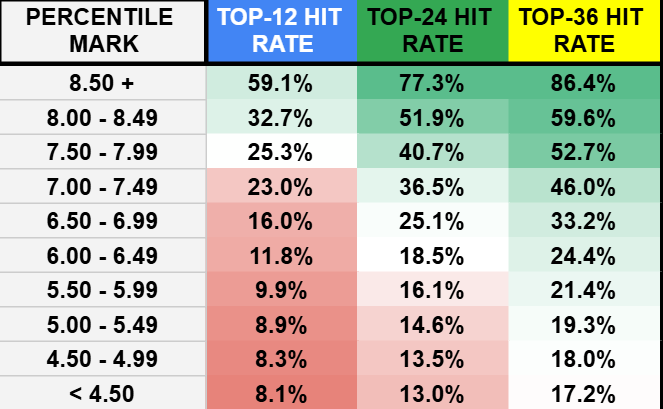
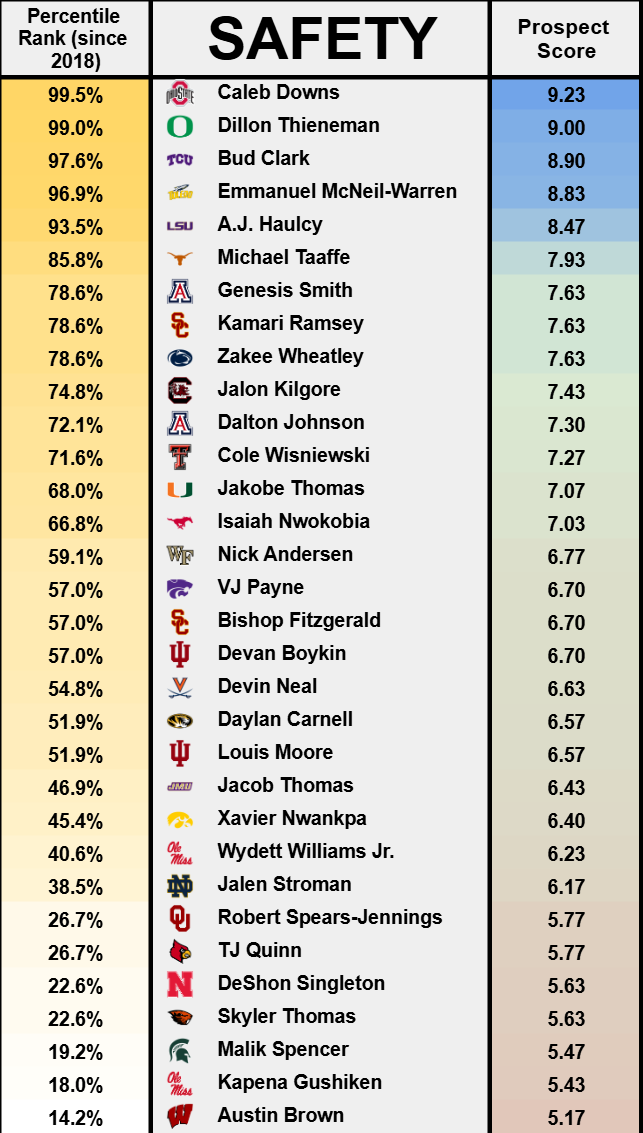
With all this in mind, it’s time to look at this year’s top scorers in the safety prospect model to identify our future IDP contributors. It should also be noted that these scores should not necessarily be used as much as your rankings, as they should be more of a guide to the player’s quality. For The IDP Show’s full rookie IDP rankings, you can check those out here.
Note: Excluded from this list is 100th overall pick Jalen Huskey, who was not a part of the consensus mock draft database that this player pool draws from.
See all of our rookie rankings content here:
Caleb Downs, Dallas Cowboys
NFL Draft Capital: 1st Round, 11th overall
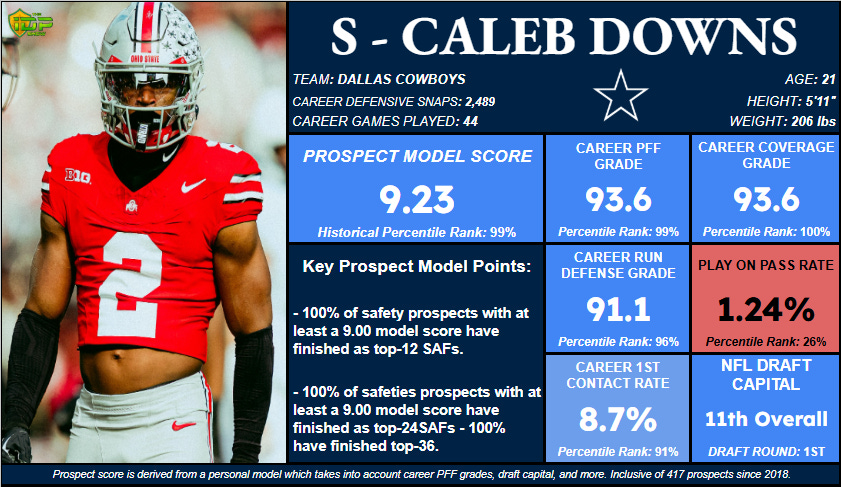
Downs owns an elite model score for the position, backing up his true “blue-chip prospect” profile, both as a future NFL player and for IDP.
Downs only scores lower than Derwin James (9.50) and Minkah Fitzpatrick (9.33) in this historical model dating back to 2018, creating significant excitement about his long-term IDP potential.
Being a safety is really the only knock against Downs’ value when it comes to IDP rookie drafts, and likely what pushes him from being a first-round pick to a second-round pick in most formats.
The real value with Downs is not necessarily in his returning S1 production every year, but rather in the expectation that IDP managers can and will use him as a weekly option for years to come.
And with that level of opportunity that he’ll carry for a long time, his odds of hitting on that S1 production each year also increase greatly.
At a position where there is so much turnover year-to-year, Downs’ talent and security in the NFL is going to carry high-end dynasty value relative to position, and in this class, that’s worth spending a second-round rookie pick on.
Dillon Thieneman, Chicago Bears
NFL Draft Capital: 1st Round, 25th overall
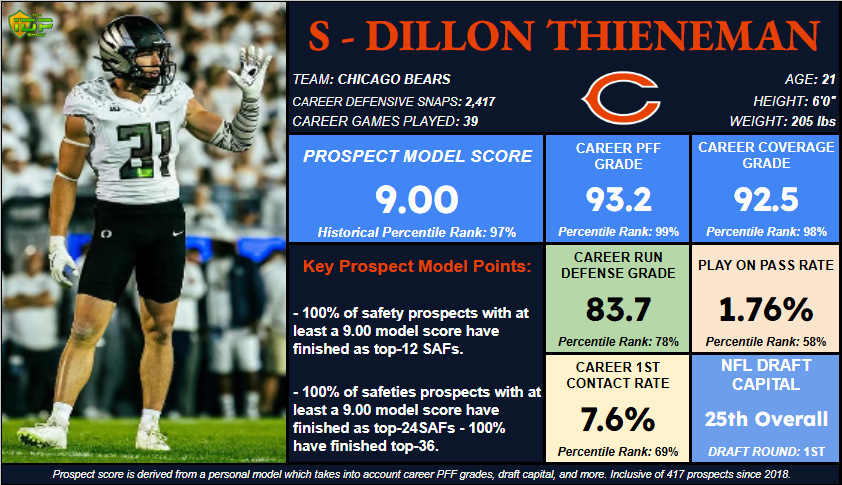
Thieneman represents the second safety in this class (Caleb Downs) to hit that elite 9.00 threshold in the model, joining the other three past performers (Derwin James, Minkah Fitzpatrick, Xavier McKinney), who have all delivered top-12 IDP performances for the position.
Thieneman was used more as a deep safety at Purdue. This past year at Oregon, he spent the majority of his snaps (53%) in the box, creating hope that he can do so at the next level as well.
Thieneman is also one of the better tacklers in this year’s class with a 97th percentile 13.2% tackle rate.
Considering that he has spent more than half of his career snaps from a deep alignment, that tackle rate is more impressive, though it should be noted that tackle rate isn’t a stable metric from college to the NFL.
First-round draft capital from the Chicago Bears, who were in need of a starting safety next to Coby Bryant, is going to create an immediate opportunity for Thieneman to deliver as an IDP, with a real shot to be the most productive of his peers on any given year.
Thieneman won’t come with as high a price tag as Caleb Downs, but the investment in him from Chicago, combined with his IDP potential, at least gives IDP managers a reason not to reach too high for Downs in drafts, when Thieneman could return comparable production.
Bud Clark, Seattle Seahawks
NFL Draft Capital: 2nd Round, 64th overall
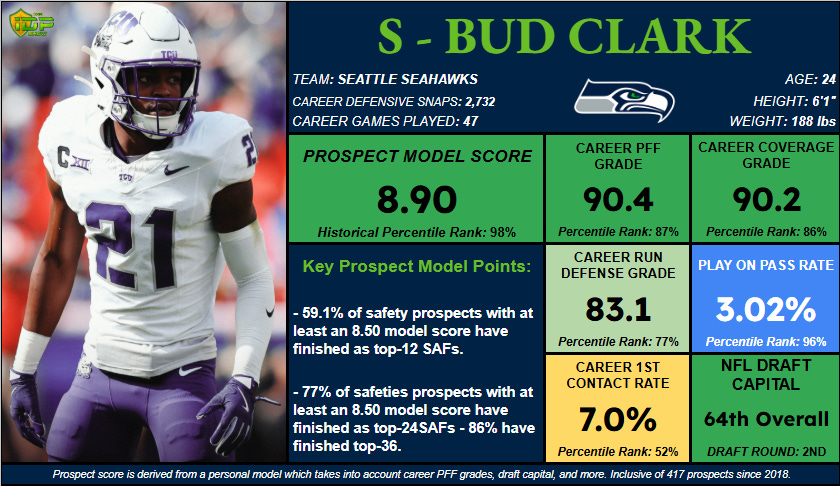
One of the real surprises from the model, Clark scored incredibly high and even earned second-round draft capital due to his enticing college metrics.
A potential hole in the model's formula is that it doesn’t factor in size at the safety position, and Clark is by far one of the lightest safety prospects in recent years, which could ultimately limit his involvement in the NFL.
What helps his potential to get on the field is that the Seattle Seahawks felt good enough about him that they took him in the second round, meaning he’ll likely have a chance to compete with Ty Okada for a starting role.
Clark is also a slightly older prospect at 24, having spent six seasons in college.
The last four years, however, Clark was one of the most productive safeties in the country with the ball in the air, coming up with 15 interceptions and an elite 3.02% play-on-pass rate (any form of getting hands on a pass, stopping a completion).
Clark still has to beat out Okada for a starting safety spot, but he has the talent, draft capital, and starting experience to make that push in Year 1.
Emmanuel McNeil-Warren, Cleveland Browns
NFL Draft Capital: 2nd Round, 58th overall
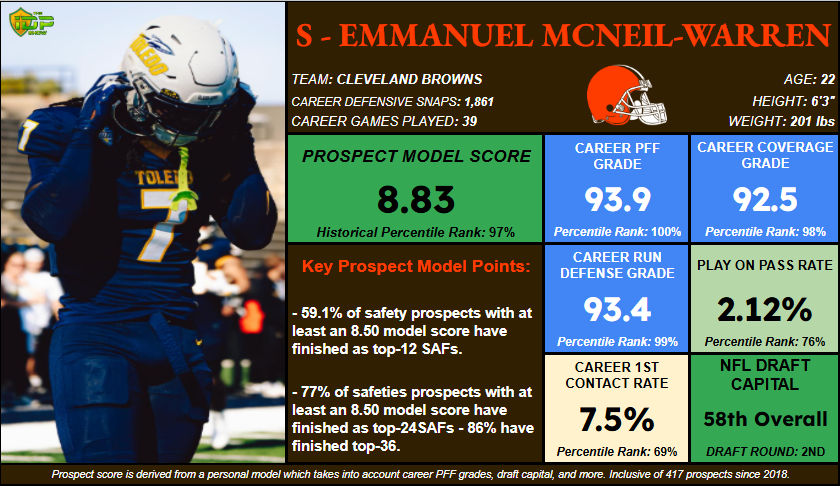
McNeil-Warren scores very well across the board, especially in terms of his career PFF grades. The only thing moving him out of the 9.00 range is that he played in the Group of Six and not the Power-Four conferences, as the level of competition is accounted for in the model.
That being said, a 97th percentile score is an elite mark to hit for any safety prospect, as all past safety prospects to score 8.80 or higher have finished as at least a top-36 IDP option, and 78% finished top-12.
Making McNeil-Warren even more enticing for IDP is his experience playing in the box, where he’s spent 52% of his career college snaps – the highest mark among any safety prospect who has actually been drafted into the league since 2018, though Dalton Johnson (150th overall in 2026) now also joins that list (60%).
McNeil-Warren should be used very similarly by the Cleveland Browns, getting the favorable IDP deployment around the line of scrimmage, making him another incredibly enticing option at the position in this year’s rookie class.
With Downs and Thieneman getting the most buzz at the moment, thanks to first-round capital, McNeil-Warren has a chance to slip under the radar just enough to make him an ideal value for a safety with such high-end IDP potential.
A.J. Haulcy, Indianapolis Colts
NFL Draft Capital: 3rd Round, 78th overall
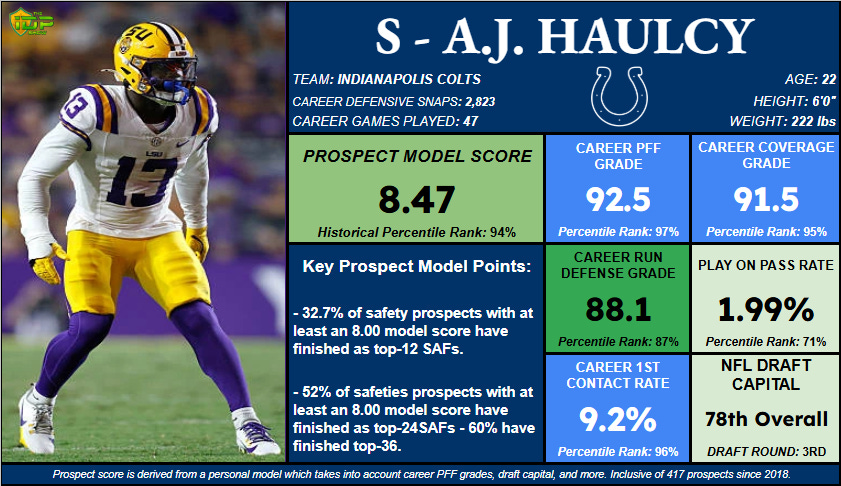
Haulcy played for three different programs during his college career, including New Mexico, Houston, and, this past season, LSU.
Haulcy’s final landing spot was built on the success that he was able to achieve at previous schools, even delivering a career-high PFF grade (86.6) and career-high coverage grade (88.6) — both top-15 marks in the FBS.
Haulcy was often projected to be a second-round pick in this year’s draft, so he slid a bit, landing in the third; however, he got the perfect landing spot to make an immediate IDP impact.
Given his versatility and ability to line up deep or in the box, Haulcy absorbing the vacated Nick Cross role from 2025 in Lou Anaroumo’s defense could pay dividends for IDP.
Cross was the overall S1 in 2025 thanks to elite tackle opportunities and efficiency, which could now belong to Haulcy if he’s able to win that starting role.
Considering the Day 2 investment in him, combined with the encouraging marks in the model, there’s no reason to temper expectations for Haulcy’s 2026 IDP potential and beyond.
High-Scoring Later-Round Picks
Michael Taaffe, Miami Dolphins
NFL Draft Capital: 5th Round, 158th overall
Current Rookie IDP Ranking: S7
Taaffe is a true deep safety prospect, having spent a high 65% of his college snaps from a free safety alignment at Texas, though he played really well in that role.
Taaffe produced back-to-back seasons with a top-20 coverage grade for his position in the FBS, resulting in a 90th percentile career coverage grade (90.6).
The Miami Dolphins were a team in need at the safety position (among others) heading into the draft, so fifth-round capital might still be enough for Taaffe to see the field in Year 1.
He’ll compete with either Dante Trader Jr. or Lonnie Johnson Jr. for a starting role, which, at least on paper, doesn’t seem too difficult, putting Taaffe in sleeper territory in this year’s class.
Genesis Smith, Los Angeles Chargers
NFL Draft Capital: 4th Round, 131st overall
Current Rookie IDP Ranking: S8
Smith is an interesting case in that he performs well in this model, despite not truly standing out in any one particular area.
He’s a great coverage safety with high-end ball production coming out of college, and he at least has average tackle production as well.
Smith doesn’t score all that well as a run defender, though that matters less than his coverage ability when translating to the next level.
His fit with the Los Angeles Chargers will be interesting, as over the past year or so, this has been a three-safety team, with Derwin James manning the slot while Tony Jefferson and Elijah Molden are expected to play more deep.
If Smith can beat out one of Jefferson or Molden, there’s a chance for him to become IDP-relevant in deeper formats.
Lower-Scoring Early-Round Picks
Jakobe Thomas, Minnesota Vikings
NFL Draft Capital: 3rd Round, 98th overall
Current Rookie IDP Ranking: S6
Thomas is a player that the model and I disagree on, it seems, as I tend to like him a little more, just outside the top-five safeties for me, while the model puts him as S13.
Thomas was also highlighted as a player to consider for deeper leagues in Scott Soltis’ Degenerate’s Draft Guide article from earlier this week.
Thomas is another player whose run defense isn’t particularly encouraging, though his career 89.3 coverage grade, combined with above-average production as a tackler and with the ball in the air, gives me hope.
On top of that, he lands with a Minnesota Vikings team that recently lost Harrison Smith (to retirement?) and has a tendency to run three-safety looks, which could open the door for Thomas to wet his beak at the NFL level in Year 1.
It should also be noted that his model score (7.07) is still a fine mark; it is simply the lowest among the Day 2 (and earlier) picks in this class.
Be sure to subscribe to The IDP Show on Apple, Spotify, or YouTube.
You can follow us on all our social media channels, including Twitter, Instagram, and TikTok.
Is Canady not included in this model because you see him only being used as a Corner?