


Dynasty rookie draft season is in full swing, and naturally, we all have a plethora of ways to evaluate how potential talent coming out of college will translate to the next level. This article series is no different, as we’ll add a fantasy football spin to the evaluation process to identify which incoming prospects have a shot to become fantasy-relevant early on in their NFL careers.
The linebacker position in IDP fantasy football has long been one of the trickier positions to find stable, quantifiable metrics worth trusting for prospect evaluation. After years of tinkering, I have identified a combination of metrics that best correlate with IDP success at the next level, leading to this prospect model that accounts for those factors and metrics for each player to derive a prospect score. As with any position, no single metric will tell us whether a college prospect will be good in the NFL, but this model’s purpose is to combine the metrics and factors that data has proven most relevant, assigning greater weight to those that are more important.
For the linebacker position, in no particular order, we’re looking at career PFF grades, run-defense grades, coverage grades, draft capital, tackle efficiency, athleticism, and level of competition faced. Underlying metrics were found to be much more reliable than overall production when accounting for all prospects. While production often comes with strong underlying metrics, the two can exist independently, and the underlying metrics have a higher success rate than overall production alone.
Keys
The prospect pool for this model consists of 364 past linebacker prospects dating back to 2018.
Twenty-seven linebackers drafted since 2018 have become a top-12 IDP finisher for their position at least once (7.4%).
Among those 27 top-12 finishers, 17 (63%) finished as top-12 finishers within their first three NFL seasons, though that number increases to 90% for those who score 8.50 or higher in the model.
Also, among those 27 top-12 finishers, 10 (37%) have been repeat top-12 finishers, though that number increases to 60% for those who score 8.50 or higher in the model.
40 linebackers drafted since 2018 have become top-24 IDP finishers for their position at least once (10.9%).
55 linebackers drafted since 2018 have become top-36 IDP finishers for their position at least once (15.1%).
This is an important context for understanding hit rates, as far more prospects will not become fantasy-relevant than in most leagues, given such a large pool of players.
However, with this model, the higher the prospect score, the higher the success rate for each prospect, as highlighted below.
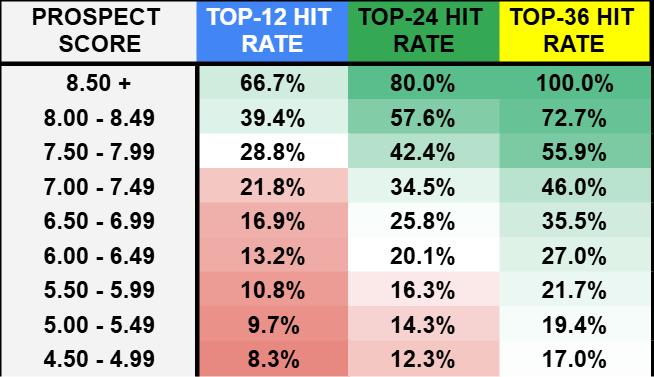
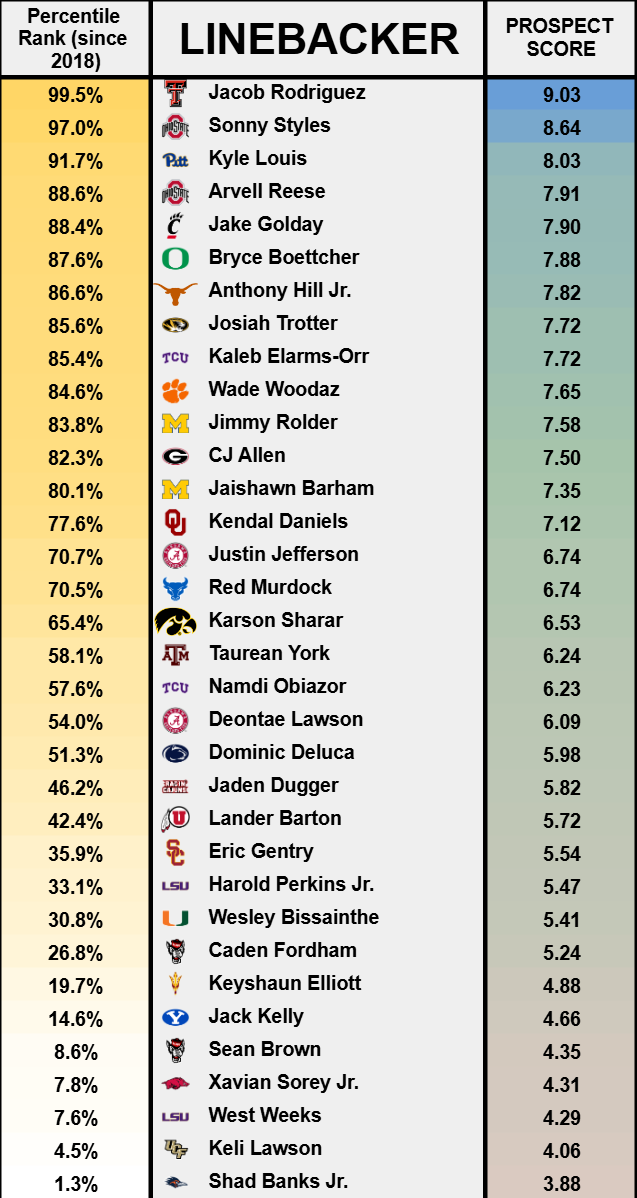
With all this in mind, it’s time to look at this year’s top scorers in the linebacker prospect model to identify our future IDP contributors. It should also be noted that these scores should not necessarily be used as much as your rankings, as they should be more of a guide to the player's quality. For The IDP Show’s full rookie IDP rankings, you can check those out here.
See all of our rookie rankings content here:
Jacob Rodriguez, Miami Dolphins
NFL Draft Capital: 2nd Round, 43rd Overall
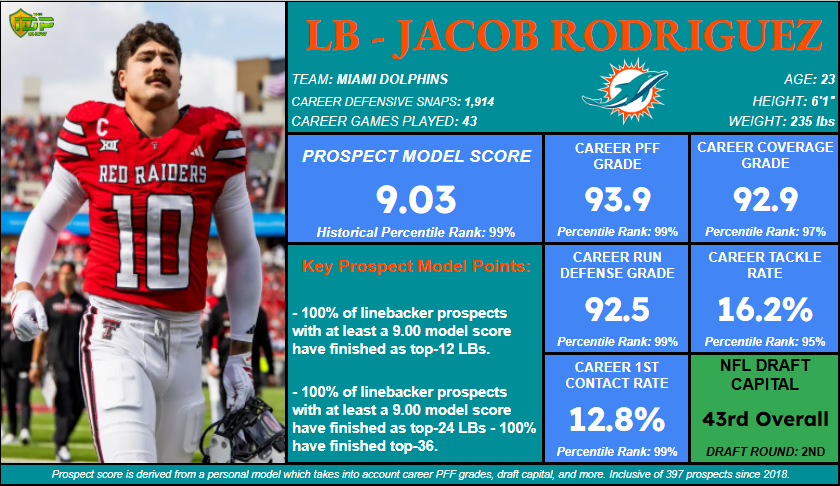
This prospect model absolutely adores Jacob Rodriguez, and it’s hard not to, if we’re being perfectly honest.
If I were to build an IDP linebacker prospect in a lab, Rodriguez would essentially be the result, complete with his mullet and mustache for the vibes.
Vibes aside, this model accounts for his raw college data, which essentially has him checking every box for high-end IDP potential.
He has no weaknesses when it comes to his career PFF grades, and his elite tackle efficiency should put him on track to IDP stardom once he takes on a starting role at the next level.
Roriguez joins just three other players to score over 9.00 in this model, including Roquan Smith (9.32), Micah Parsons (9.04), and Jack Campbell (9.03) — all of whom hit on their top-12 IDP potential within the first three years of their careers.
IDP dynasty managers would be well-served to be patient with Rodriguez, not to panic about the landing spot if he has to sit behind Jordyn Brooks and Tyrel Dodson in Year 1, because Rodriguez should get his shot sooner rather than later, and once he does, he has all the makings of an IDP star.
Sonny Styles, Washington Commanders
NFL Draft Capital: 1st Round, 7th Overall
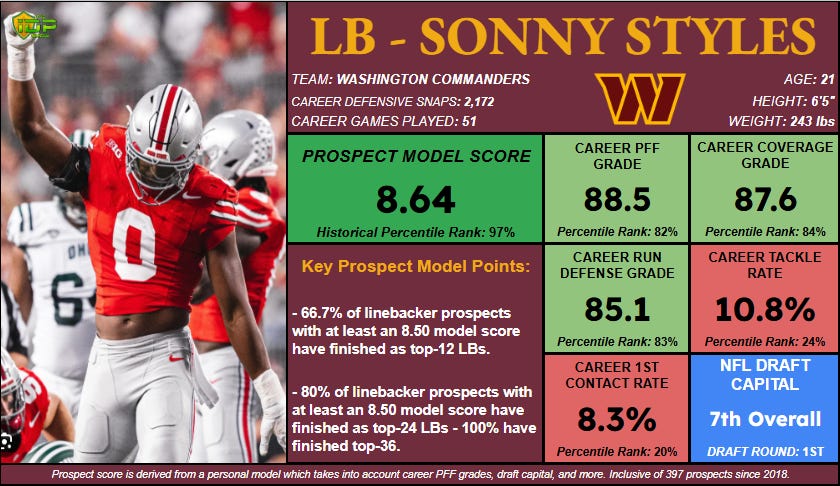
While Styles comes in just behind Jacob Rodriguez as LB2 in this class, according to the model scores, he’s LB1 for IDP, as his draft-capital-and-talent combination makes him one of the safest bets for IDP success in recent years.
Top-10 draft capital is rare for the position — though there were two in this year’s draft — and that level of investment all but guarantees that Styles will get every opportunity to prove that he’s worth it, and when it comes to IDP, nothing matters more than opportunity.
Styles scores very well in the prospect model, delivering high grades for his college career, putting him in an ideal bucket of past top IDP finishers, including Fred Warner, Jordyn Brooks, Nick Bolton, and Zack Baun.
I’m sure you’ll have noticed the tackle and first-contact rate for Styles, which isn’t a major concern for me, as this came almost entirely from his usage, having played 15.1% of his college snaps on the edge.
That usage is almost identical to Jordyn Brooks (14.7%), who also had a below-average career college tackle rate (12.1%), and he has been more than fine for IDP at the next level.
Styles also fits nicely into Dan Quinn’s defense as he’s more than capable of doing everything Quinn will ask him to do, playing on the edge, dropping into coverage, and leading the way at off-ball on run downs.
Styles should be considered a lock for IDP success at this point, all things considered, and well worth a first-round pick in IDP rookie drafts this year.
Kyle Louis, Miami Dolphins
NFL Draft Capital: 4th Round, 138th Overall
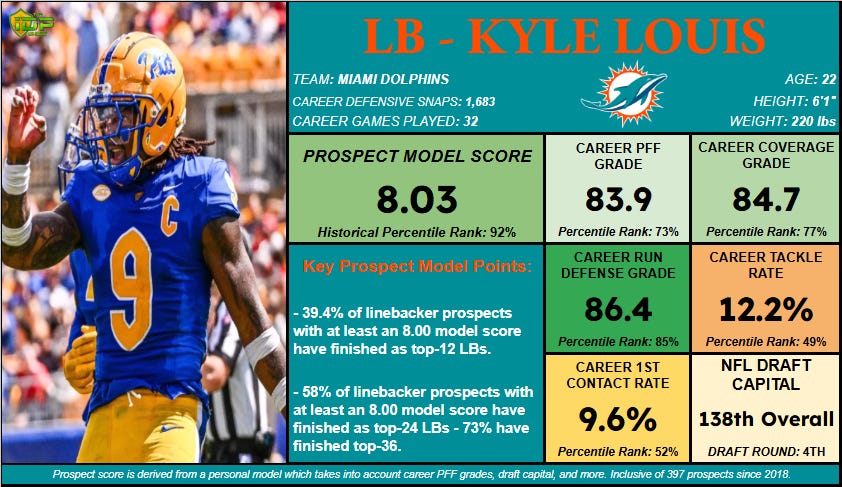
Louis is another Miami Dolphins player that this model is a big fan of. Despite the fact that he was taken with fourth-round capital, he checked enough of the other heavily weighted boxes to rise up the board.
As a two-year starter at Pitt, Louis never really posted a concerning PFF grade across the board, and the combination of above-average scores in both run defense and coverage ended up being a rare key to boost his score.
Louis’ career tackle rate isn’t strong, but, much like Sonny Styles, a big part of that stems from his usage: he's played 15% of his career snaps on the edge and 35% in the slot.
That unique linebacker usage makes Jeremiah Owusu-Koramoah a good comp for Louis, at least from a usage standpoint, though NFL Draft capital and some underlying metrics are a fair bit different.
Louis also thrived as a tackler near the line of scrimmage, delivering a 2.0% rate of tackles at or behind the line of scrimmage, which is an 83rd percentile mark among prospects since 2018.
Even more so than Rodriguez, IDP dynasty managers may need to be patient with Louis before he becomes IDP-relevant, if at all, but on a rebuilding defense, there’s at least hope that Year 2 could result in a starting role with Jordyn Brooks and Tyrel Dodson’s contracts set to expire at the end of this season.
Arvell Reese, New York Giants
NFL Draft Capital: 1st Round, 5th Overall
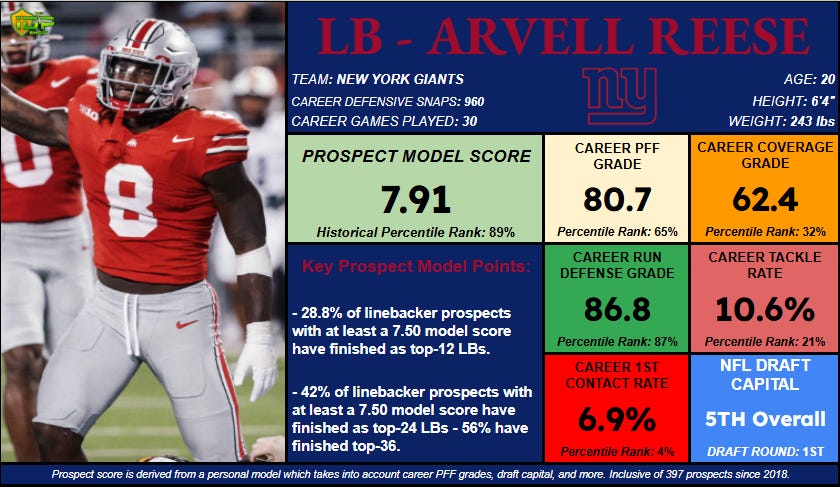
Reese is a unique linebacker prospect in that he comes out of college as a hybrid EDGE-LB archetype, which is partly what makes him so valuable from an NFL standpoint, but also creates some hesitation about his IDP potential.
Because of that usage in college, the prospect model is naturally going to penalize him a bit more than most, as that role just didn’t allow him to thrive in any one specific area, especially when it came to tackle production.
Given the 36% of his snaps that Reese spent on the edge, there was naturally going to be a significant drop-off in tackle rate, hence the bottom quartile scores in that regard, as well as first-contact rate.
Without a true idea of how Reese will be used at the next level, though, head coach John Harbaugh did come out and say he’ll be used more at off-ball, which should help us all feel better about his IDP production floor on top of his higher upside as a blitzer/pass-rusher.
And Reese does have arguably the highest upside of any IDP in this year’s class if he can deliver on what will likely be plenty of pass-rushing opportunities, even if he’s spending most of his time at off-ball.
There’s a lot to like about his potential for IDP, and the kind of high-ceiling player we should all be looking for to give us that competitive edge against the rest of our league.
Even as the fifth-overall pick in this year’s draft, Reese’s model score isn’t overly compelling, but for all those reasons we just went over, he’s well worth spending a first-round rookie pick on in most IDP formats for upside alone.
Jake Golday, Minnesota Vikings
NFL Draft Capital: 2nd Round, 51st Overall
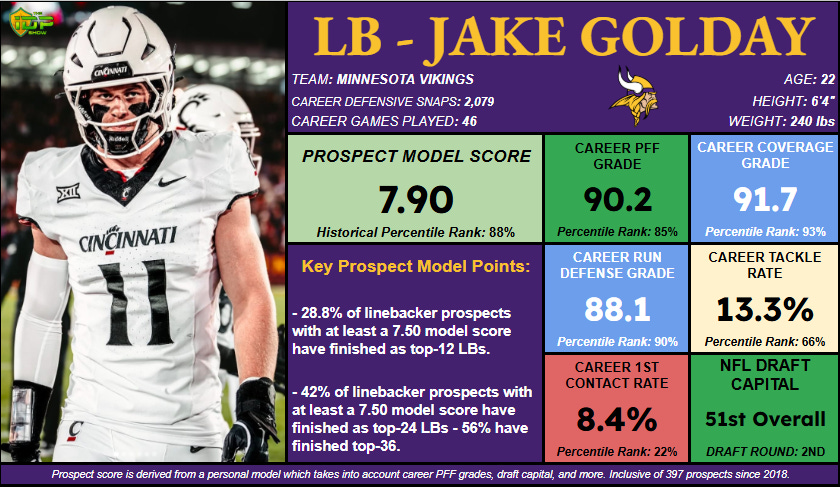
Golday is another high-end performer in the model and was drafted in Round 2. While his excellent combination of coverage and run defense grades is impressive, his overall score took a slight hit after spending three years in the FCS.
The model does try to account for the level of competition when using PFF grades, so that’s part of why Golday isn’t ahead of someone like Kyle Louis, despite slightly better grades.
That being said, it’s where we, as dynasty managers and drafters, can insert personal bias into our rankings and recognize that Golday’s best years came in the Power Four while he was at Cincinnati, which helped him earn that second-round capital.
Golday started his college career as an edge defender at Central Arkansas (2021-2022), before converting to more of an off-ball linebacker, and then over the past two seasons at Cincinnati, where he was used everywhere.
Since transferring to Cincinnati in 2024, Golday has played 44% of his snaps in the slot, 16% on the edge, and just 40% in a true off-ball role.
In Brian Flores’ scheme in Minnesota, Golday will likely see similarly versatile usage, which could make it tougher to sustain consistent IDP production.
Year 1 isn’t likely where we’ll get the best return on investment from Golday as the rookie LB5 at the moment, but with Blake Cashman on the last year of his deal, there’s hope that Golday can take over a starting spot as soon as 2027, which will create a significant value boost.
High-Scoring Later-Round Picks
Bryce Boettcher, Indianapolis Colts
NFL Draft Capital: 4th Round, 135th Overall
Current Rookie IDP Ranking: LB12
Boettcher was incredibly productive at Oregon (16.8% career tackle rate), though on a smaller sample size.
Going 4th Round to the Colts probably helps his IDP outlook even more, combined with his strong 7.88 score in the model (88th percentile).
Boetcher’s path to snaps as a rookie is likely among the best of any Day 3 linebacker in this class, considering the Colts’ thin depth chart, and if he can get on the field, there’s certainly IDP potential worth targeting there later in rookie drafts.
Kaleb Elarms-Orr, Buffalo Bills
NFL Draft Capital: 4th Round, 126th Overall
Current Rookie IDP Ranking: LB8
Elarms-Orr was an immediate starter as a freshman at Cal, before transferring to TCU, where it took him one more season to become a full-time starter there, though he had a breakout season in doing so.
Elarms-Orr ranked top-20 at his position in the FBS in PFF grade (84.4), and top-15 in run defense grade (89.1).
Landing with the Bills could turn out to be an ideal landing spot with only really Dorian Williams ahead of him on the depth chart for that LB2 spot, and considering new defensive coordinator Jim Leonhard is taking over with no ties to the previous personnel, there’s room for Elarms-Orr to uncover an IDP-relevant role as soon as this season.
Wade Woodaz, Houston Texans
NFL Draft Capital: 4th Round, 123rd Overall
Current Rookie IDP Ranking: LB11
Woodaz is a two-year starter coming out of Clemson, where he spent all four of his college seasons.
IDP managers are undoubtedly wary by this point when it comes to Clemson linebackers, with the likes of Isaiah Simmons, Trenton Simpson, and Dorian O’Daniel having been top-100 picks in the past and all failing to gain any real traction for IDP.
Barrett Carter is currently an exception, getting a full-time role as a rookie, though struggling mightily within that role, which creates at least some uncertainty about how long he’ll hold that spot.
Woodaz actually scores slightly better (7.65) than Carter (7.61) in the model, and both were drafted outside of the top-100, so while expectations should remain tempered, perhaps this recent Clemson duo can start a new trend.
Jimmy Rolder, Detroit Lions
NFL Draft Capital: 4th Round, 118th Overall
Current Rookie IDP Ranking: LB13
Lastly, another relatively early Day 3 pick, Rolder lands with the Lions, who recently declined Jack Campbell’s fifth-year option, and Alex Anzalone is off to Tampa Bay, creating at least a slightly more optimistic path to snaps for Rolder in Detroit.
While Rolder crosses that 7.50 threshold (7.58) to make this cut, he does so on a sub-optimal sample size with fewer than a thousand defensive snaps to his name across four college seasons at Michigan.
That being said, Rolder is a strong tackler and run defender, posting an 85th percentile career tackle rate (14.6%) with just a 5.8% missed tackle rate (97th percentile), making him at least an intriguing rookie sleeper.
Lower-Scoring Early-Round Picks
Jaishawn Barham, Dallas Cowboys
NFL Draft Capital: 3rd Round, 91st Overall
Current Rookie IDP Ranking: LB10
Barham was the lone third-round linebacker selected in this draft, though a lot of outlets had him projected as an edge at the next level, despite Dallas insisting he’ll start at off-ball.
The confusion about Barham’s projected role in the NFL stems from his playing two different positions over the past two years at Michigan: an EDGE in 2025 and an off-ball linebacker in 2024.
While he has experience at both, and could likely get work doing both in the NFL, he hasn’t exactly thrived in either role, which limits his IDP potential even more on top of the inconsistent production tied to a hybrid linebacker role.
CJ Allen, Indianapolis Colts
NFL Draft Capital: 2nd Round, 53rd Overall
Current Rookie IDP Ranking: LB4
Allen landed in the perfect situation to become an immediate IDP star with the Indianapolis Colts in a desperate spot for a starting-caliber linebacker.
Along with second-round capital, landing spot is a big reason for Allen cracking the top-five rookie linebackers in this class as a potential second-round rookie draft pick.
It is worth noting, however, that he struggled in coverage (54.3 career coverage grade, 18th percentile), and his overall career grade (79.7) ranked just 59th percentile.
Part of the reason for this is likely that he was dealing with injuries, which is also why he didn’t participate in the NFL Combine, and likely contributed to his score not being quite as high as his Round 2 peers.
However, if Allen is healthy and gets the starting role we certainly expect, he could be a significant IDP contributor in 2026 and beyond.
Be sure to subscribe to The IDP Show on Apple, Spotify, or YouTube.
You can follow us on all our social media channels, including Twitter, Instagram, and TikTok.
How would I go about looking at previous years posts?