



Dynasty rookie draft season is in full swing, and naturally, we all have a plethora of ways to evaluate how potential talent coming out of college will translate to the next level. This article series is no different, as we’ll add a fantasy football spin to the evaluation process to identify which incoming prospects have a shot to become fantasy-relevant early on in their NFL careers.
The defensive line position in IDP fantasy football often comes with at least several more stable metrics to help us project these players to the next level and evaluate prospects. That is why the EDGE model was the first one that I started with back in the day, and why it dates back further (2016) than the other models. With all these metrics in place, this prospect model accounts for each player's factors and metrics to derive a prospect score. As with any position, no single metric will tell us whether a college prospect will be good in the NFL, but this model’s purpose is to combine the metrics and factors that data has proven most relevant, assigning greater weight to those that are more important.
For the edge position, in no particular order, we’re looking at PFF pass-rush grades, pass-rush win rate, pressure rate, run-defense grades, draft capital, athleticism, and level of competition faced. There is some weight to one-year numbers, though the most stable metrics, with the most weight applied, are career numbers. Underlying metrics were also found to be much more reliable than overall production when accounting for all prospects. While production often comes with strong underlying metrics, the two can exist independently, and the underlying metrics have a higher success rate than overall production alone.
Keys
The prospect pool for this model consists of 320 past edge prospects dating back to 2016.
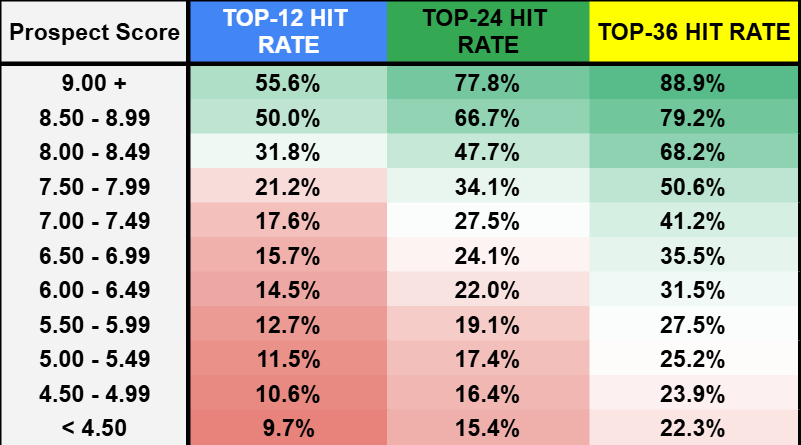
31 edges drafted since 2016 have become a top-12 IDP finisher for their position at least once (9.7%).
Of those 31 top-12 finishers, 15 (48%) of them finished as top-12 finishers within their first three NFL seasons, though that number increases to 67% for those who score 8.50 or higher in the model.
Also, among the 31 top-12 finishers, 14 (45%) are repeat top-12 finishers, though that number rises to 50% for those who score 8.50 or higher in the model.
49 edges drafted since 2016 have become a top-24 IDP finisher for their position at least once (15.3%).
71 edges drafted since 2016 have become a top-36 IDP finisher for their position at least once (22.2%).
This is an important context for understanding hit rates, as far fewer prospects will become fantasy-relevant than in most leagues, given such a large pool of players.
However, with this model, the higher the prospect score, the higher the success rate for each prospect, as highlighted below.
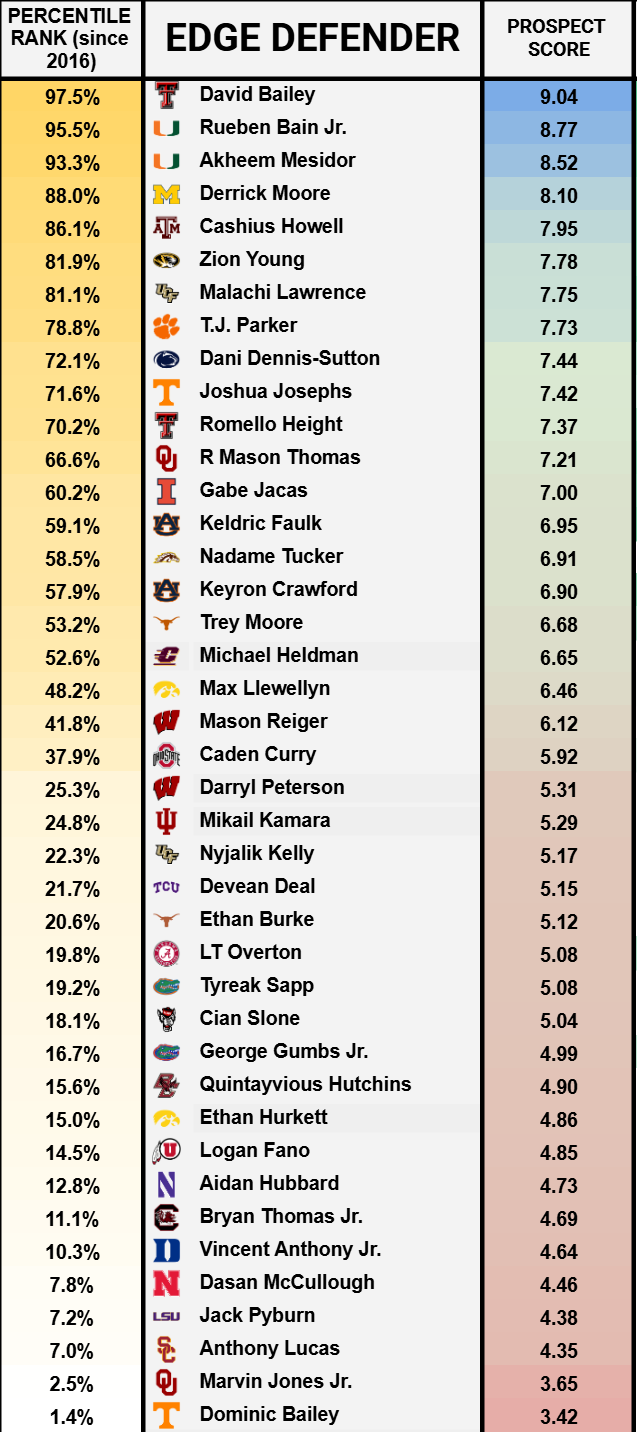
With all this in mind, it’s time to look at this year’s top scorers in the EDGE prospect model to identify our future IDP contributors. It should also be noted that these scores should not necessarily be used as much as your rankings, as they should be more of a guide to the player’s quality. For The IDP Show’s full rookie IDP rankings, you can check those out here.
See all of our rookie rankings content here:
David Bailey, New York Jets
NFL Draft Capital: 1st Round, 2nd overall
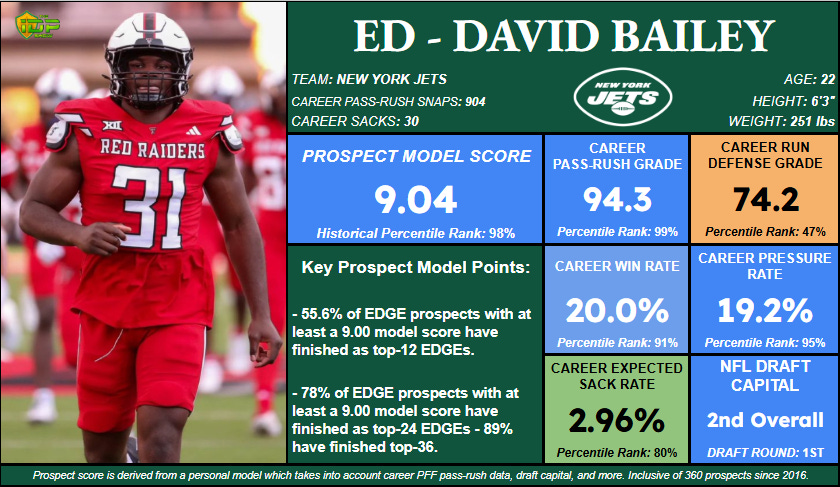
Bailey has led the Power-Four conferences in pass-rush grade in each of the past two seasons, contributing to an outstanding 94.3 career mark in that regard.
Bailey’s first three seasons were spent at Stanford, where his overall playing time wasn’t nearly as high as it was this past season after transferring to Texas Tech, essentially doubling his total pass-rush opportunities from the previous year, and helping prove that his conference-leading 2024 pass-rush grade was no fluke.
Only Chase Young (95.4) and Myles Garrett (94.4) had higher career pass-rush grades than Bailey among past Power-Four EDGEs since 2016.
Bailey falters a bit on run defense, ranking in the 47th percentile for his career, though his 2025 season was a big step in the right direction.
Bailey posted an 81.5 run defense grade this past season, which ranked 26th in the FBS among edge defenders, so he greatly improved on a larger sample size.
As the second overall pick, Bailey is going to get plenty of pass-rushing opportunities and figures to be a high-upside IDP option worthy of a late-first or early-second round pick in rookie drafts.
Rueben Bain Jr., Tampa Bay Buccaneers
NFL Draft Capital: 1st Round, 15th overall
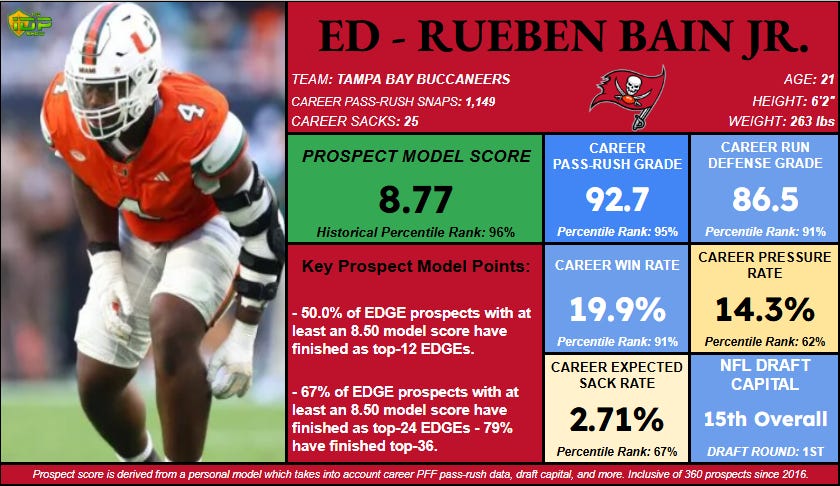
Bain is coming off a massive 2025 season, in which he finished top 10 at his position in the Power-Four conferences in pass-rush grade (92.4), led the position in total pressures (83), and finished second in win rate (23.5%).
Bain owns elite pass-rush marks across the board, minus his pressure rate, which suggests that some of his pressure production was more compiled through playing time than hitting immediately, which is also highlighted by his 67th percentile quick pressure rate (10.1%).
These aren’t major red flags by any means, and with the majority of his pass-rush metrics all checking the boxes we’re looking for, my belief is he’ll be a solid IDP asset for us in Tampa Bay.
Bain even boasts high-end run defense marks, which set him apart somewhat from Bailey and put him in rare territory among other top scorers in the model.
Among those who have scored 8.50 or higher in the model, only five other prospects have achieved a higher career run defense grade within that model score range: Nick Bosa, Will Anderson Jr., Aidan Hutchinson, Joey Bosa, and Mike Green.
Four of those five have all been top-12 IDP scorers in their careers, while Green is the lone exception after his rookie year.
While Bain slid a bit in the NFL Draft due to concerns around his (1st percentile) arm length, he still gets great capital and a landing spot where he could explode as an IDP asset, which puts him in that early 2nd round range of rookie drafts at the very least.
Akheem Mesidor, Los Angeles Chargers
NFL Draft Capital: 1st Round, 22nd overall
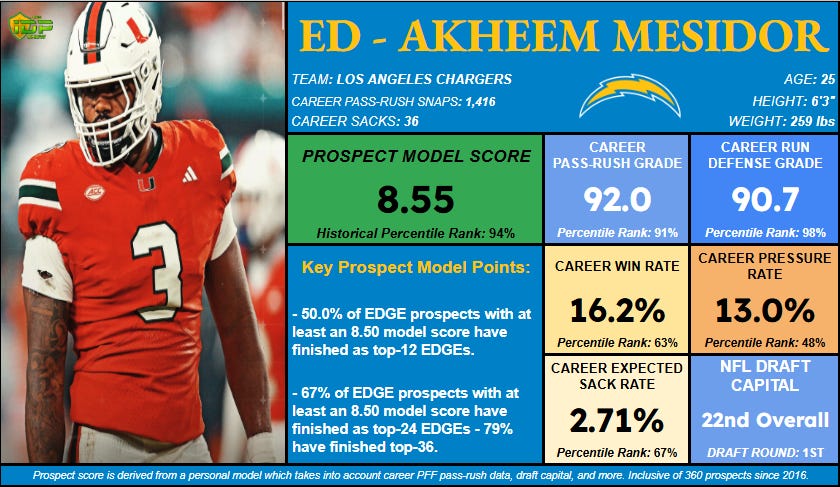
Mesidor is already 25-years-old, having played six college seasons at West Virginia (2020-2021) and Miami (2022-2025).
However, Mesidor has a strong combination of pass-rush and run-defense metrics that put him in consideration as a clear IDP option.
Mesidor’s pass-rush metrics tend to be a little inconsistent from year-to-year in college, which is why his win and pressure rates come in a little lower, though he certainly finished on a high note with a 92.5 pass-rush grade — a top-10 mark in the FBS.
Much like Bain, Mesidor joins that small, exclusive club of elite run defenders, backing up the overall quality of the model score, with only Nick Bosa and Joey Bosa posting a higher run defense grade than him among 8.50 or higher scorers in the model.
Making his selection more encouraging for IDP dynasty rookie drafters is that the Los Angeles Chargers felt strongly enough about his potential to take him in the first round, presumably as the Khalil Mack replacement, as soon as next season.
Mesidor fits in more toward the end of the second or early third round of rookie drafts for me right now, though it wouldn’t be a surprise to see him slip a bit further down boards given the depth at the position.
Derrick Moore, Detroit Lions
NFL Draft Capital: 2nd Round, 44th overall
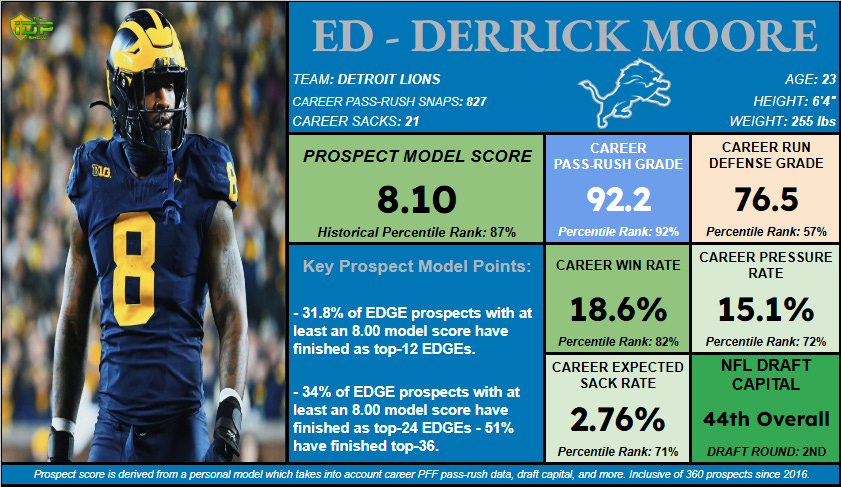
Moore was one of the big risers from this year’s EDGE class, as he was projected closer to Round 3 during the pre-draft process, but rightfully so, he lands with the Detroit Lions in the middle of Round 2.
Moore has consistently improved as a pass rusher throughout his college career at Michigan, culminating in an elite 92.4 pass-rush grade in 2025 — a top-10 mark in the FBS.
2025 was a landmark year for Moore, as he not only stood out in terms of his underlying metrics, but he also more than doubled his career sack total as well.
The Lions have been in need of another pass-rushing threat opposite Aidan Hutchinson, and Moore has arguably the best chance to deliver on that potential for them.
He’ll compete with D.J. Wonnum for that ED2 role along Detroit’s defensive line, and while it may take him a season to get up to speed in the NFL, he is currently the betting favorite (for my money) among those on the roster to be the most effective in that role, other than Hutchinson, of course.
Cashius Howell, Cincinnati Bengals
NFL Draft Capital: 2nd Round, 41st overall
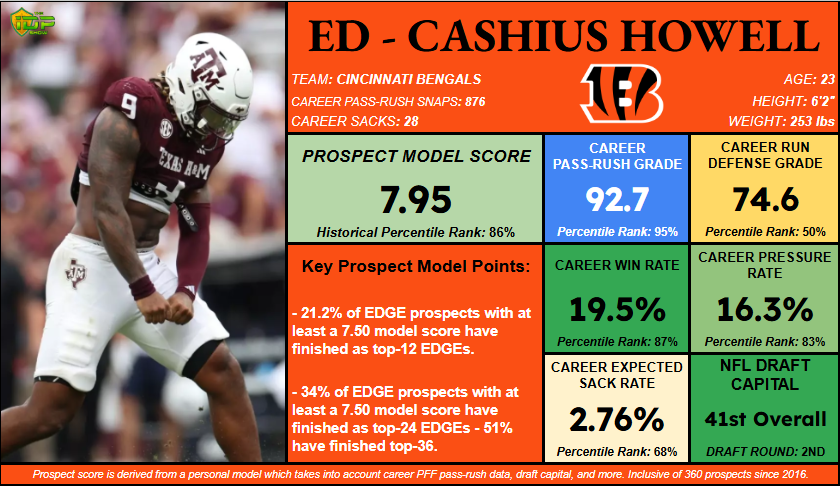
While much has been made of Rueben Bain’s arm length, Cashius Howell faces identical concerns, as he, too, measures in the bottom 1st percentile in arm length (30.25”) and wingspan (74.24”), according to Mockdraftable.
While he wasn’t invested in as highly as Bain with the 15th overall pick, Howell was still the Cincinnati Bengals first selection in this year’s draft, and the second consecutive season that they selected a pass rusher relatively high out of Texas A&M (Shemar Stewart, 2025).
Howell, even with his flaws, owns significantly stronger pass-rush metrics than Stewart, delivering three straight seasons with at least a 90.3 pass-rush grade, including his final year at Bowling Green (2023), before transferring to Texas A&M.
Opportunity will be the key to Howell’s IDP success early in his NFL career, as the Bengals lack star power off the edge after losing Trey Hendrickson, so if Howell can earn a larger role in Year 1, he has a path to being the top IDP EDGE option in Cincinnati, worthy of a mid-round pick in rookie drafts.
High-Scoring Later-Round Picks
Dani Dennis-Sutton, Green Bay Packers
NFL Draft Capital: 4th Round, 120th overall
Current Rookie IDP Ranking: ED11
As highlighted in Scott Soltis’ Degenerate’s Draft Guide this week, Dennis-Sutton is one of the standout Day 3 edge defenders in this class, thanks to strong marks as a pass rusher and above-average marks as a run defender.
Dennis-Sutton is also an elite athlete with a 9.96 Relative Athletic Score (RAS), which suggests he can translate to the NFL despite being a Day 3 pick.
Landing with the Green Bay Packers is also an ideal spot for a good rookie edge defender to earn snaps, with Micah Parsons coming off injury, Lukas Van Ness struggling to make any kind of impact through his first three NFL seasons, and the team just being overly thin at the position.
Joshua Josephs, Washington Commanders
NFL Draft Capital: 5th Round, 147th overall
Current Rookie IDP Ranking: ED13
Josephs consistently improved on his pass-rushing ability over his college career at Tennessee, culminating in a 90.6 pass-rush grade in 2025 (16th in the FBS), though he was relatively unlucky in the sack column.
His lower sack output mostly comes from a rotation-heavy scheme where he never cracked 200 pass-rush snaps in a season, though his expected sack rate, based on his underlying metrics and playing time, at least sits at the 67th percentile among prospects (2.71%).
Josephs will likely be part of a rotation once again with the Washington Commanders, at least early in his career, but if he continues to develop and make an impact with his limited opportunities, he could be considered a name to keep an eye on in deeper formats.
Lower-Scoring Early-Round Picks
Keyron Crawford, Las Vegas Raiders
NFL Draft Capital: 3rd Round, 67th overall
Current Rookie IDP Ranking: ED14
Crawford gets a decent enough landing spot and draft capital with the Las Vegas Raiders, though he doesn’t project as an immediate impact player due to average-to-below-average marks across the board.
Crawford isn’t a bad pass rusher by any means, but in combination with poor run defense metrics, likely puts him as a rotational pass rusher at the next level, which won’t carry much value in most IDP formats.
Keldric Faulk, Tennessee Titans
NFL Draft Capital: 1st Round, 31st overall
Current Rookie IDP Ranking: ED6
Faulk gets great draft capital and an ideal landing spot with the Tennessee Titans, though his career pass-rush metrics raise significant red flags for his IDP potential.
Faulk scores in the bottom 20th percentile among prospects since 2016 in pass-rush grade and win rate, which points to him being more of a raw project-type pass rusher in the NFL.
Faulk’s outlook improves, and he ranks as ED6 in this rookie class for IDP because he is a top-tier run defender with ideal capital and is in a great landing spot to get as many opportunities as he can handle and hit his IDP potential.
Gabe Jacas, New England Patriots
NFL Draft Capital: 2nd Round, 55th overall
Current Rookie IDP Ranking: ED13
Jacas posted strong pass-rush marks in his final two seasons at Illinois, and, combined with high-end athleticism (9.59 RAS), he earned ideal second-round draft capital.
The concerns for Jacas are similar to those with Keyron Crawford, in that his run defense marks are so poor, highlighted by a 64.5 career run defense grade (13th percentile), that his path is likely that of a designated pass rusher.
Jacas has an average size for the position, and with the investment in him, it’s not out of the realm of possibilities that he develops into a better run defender for New England, but it may take some time for him to return any real IDP value with that projected path.
Be sure to subscribe to The IDP Show on Apple, Spotify, or YouTube.
You can follow us on all our social media channels, including Twitter, Instagram, and TikTok.
Stellar work, Jon
Any kind of updated IDP rookie rankings anywhere? Enjoy the content. 👍