


Dynasty rookie draft season is in full swing, and naturally, we all have a plethora of ways to evaluate how potential talent coming out of college will translate to the next level. This article series is no different, as we’ll add a fantasy football spin to the evaluation process to identify which incoming prospects have a shot to become fantasy-relevant early on in their NFL careers.
For the defensive tackle position, the prospect model accounts for the most important factors and metrics for a player to achieve relevant IDP success in the NFL. As with any position, no single metric will tell us whether a college prospect will be good in the NFL, but the purpose of this model is to combine the metrics and factors that data has proven most relevant, assigning weight to those that are more important than others.
For the defensive tackle position, in no particular order, we’re looking at PFF pass-rush grades, pass-rush win rate, pressure rate, run-defense grades, draft capital, athleticism, and level of competition faced. There is some weight to one-year numbers, though the most stable metrics, with the most weight applied, are career numbers. Underlying metrics were also found to be much more reliable than overall production when accounting for all prospects. While production often comes with strong underlying metrics, the two can exist independently, and the underlying metrics have a higher success rate than overall production alone.
Keys
The prospect pool for this model consists of 406 defensive tackle prospects dating back to 2018.
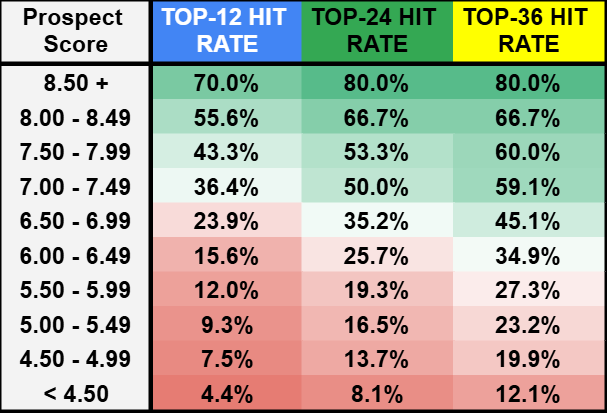
Eighteen defensive tackles drafted since 2018 have become a top-12 IDP finisher for their position at least once (4.4%).
Of those 18 top-12 finishers, 11 (61%) finished as top-12 finishers within their first three NFL seasons.
Also, of those 18 top-12 finishers, seven of them (39%) have been repeat top-12 finishers.
Thirty-three defensive tackles drafted since 2018 have become a top-24 IDP finisher for their position at least once (8.1%).
Forty-nine defensive tackles drafted since 2018 have become a top-36 IDP finisher for their position at least once (12.1%).
This is an important context for understanding hit rates, as far fewer prospects will become fantasy-relevant than in most leagues, given such a large pool of players.
However, with this model, the higher the prospect score, the higher the success rate for each prospect, as highlighted below.
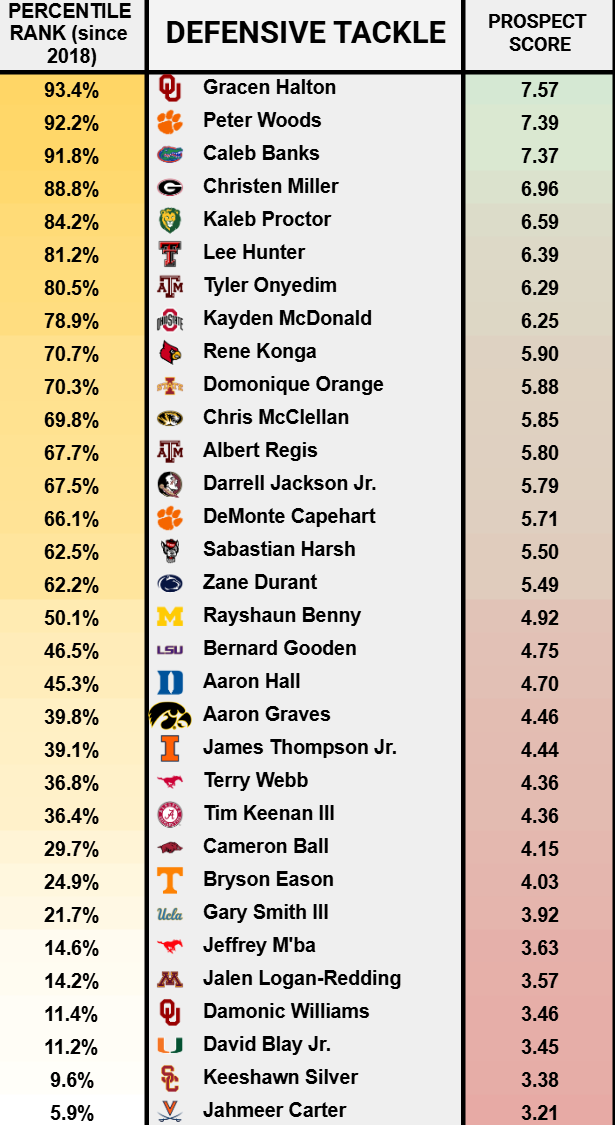
With all this in mind, it’s time to look at this year’s top scorers in the defensive tackle prospect model to identify our future IDP contributors. It should also be noted that these scores should not necessarily be used as much as your rankings, as they should be more of a guide to the player’s quality. For The IDP Show’s full rookie IDP rankings, you can check those out here.
See all of our rookie rankings content here:
Gracen Halton, San Francisco 49ers
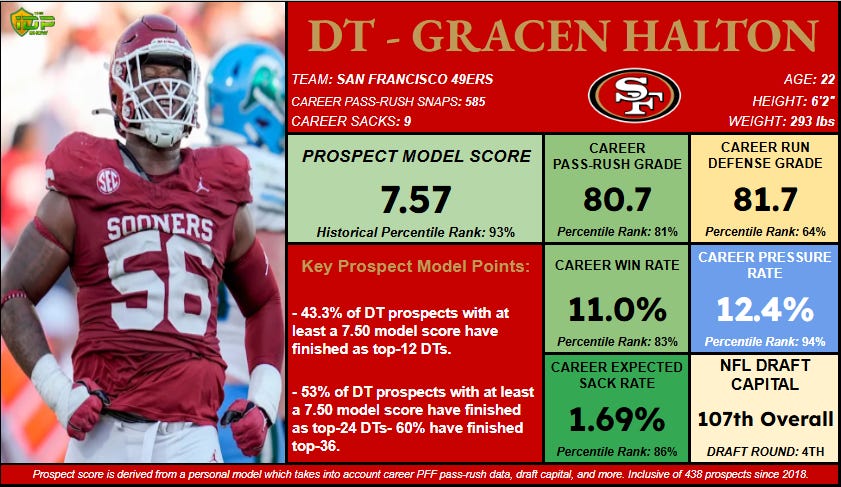
NFL Draft Capital: 4th Round, 107th overall
This year’s defensive tackle class is somewhat underwhelming when it comes to truly high-end IDP prospects, though that is also the nature of the position as a whole.
Halton’s 7.57 prospect model score is at the 93rd percentile, which also speaks to the rarity of scores much higher (8.00 and above), though his potential for IDP is still solid.
With this in mind, Halton becomes a great DT-required sleeper option, which was also highlighted in Scott Soltis’ Degenerate’s Draft Guide article from earlier this week.
Halton isn’t an elite pass rusher, but he has been consistently strong, posting at least a 71.8 pass-rush grade in each of his past three seasons at Oklahoma.
Over the last two seasons, that level of talent helped Halton produce all nine of his career college sacks and 85% of his total pressures.
Halton will have an opportunity to work his way up the San Francisco 49ers’ depth chart next to Osa Odighizuwa, as the team lacks other strong options, and should definitely be on DT-required IDP radars.
Peter Woods, Kansas City Chiefs
NFL Draft Capital: 1st Round, 29th overall
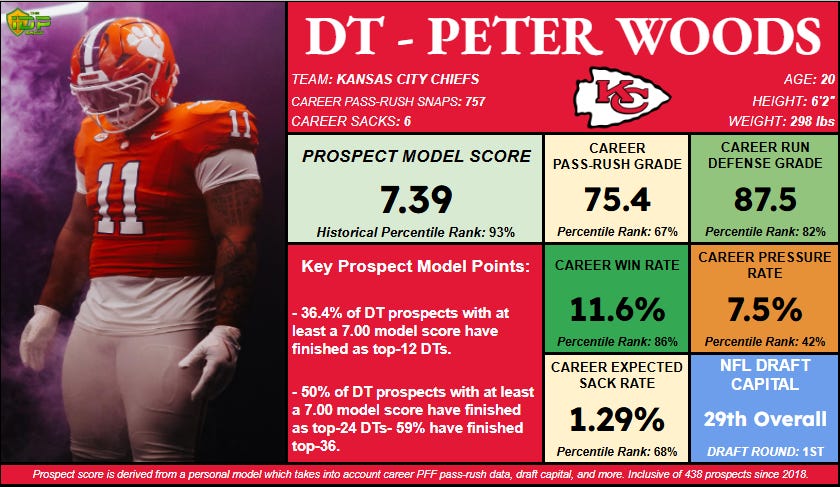
Woods wasn’t the first defensive tackle drafted in the NFL Draft, despite him being almost unanimously mocked as such during the pre-draft process, and that does come partly from at least some red flags.
Woods wasn’t the most productive pass-rusher coming out of college, with just six sacks, though his win rate says that he was certainly deserving of more.
Unfortunately, based on the metrics, we’re looking at likely later wins in his reps, as his career pressure rate is also much lower than expected compared to his wins.
Helping Woods is that he gets that strong first-round capital from a team in need of an immediate contributor next to Chris Jones.
While Woods shouldn’t be expected to produce DT1 numbers early in his career, his potential for playing time should help create enough production to make him a valuable depth option in DT-required formats in Year 1.
Caleb Banks, Minnesota Vikings
NFL Draft Capital: 1st Round, 18th overall
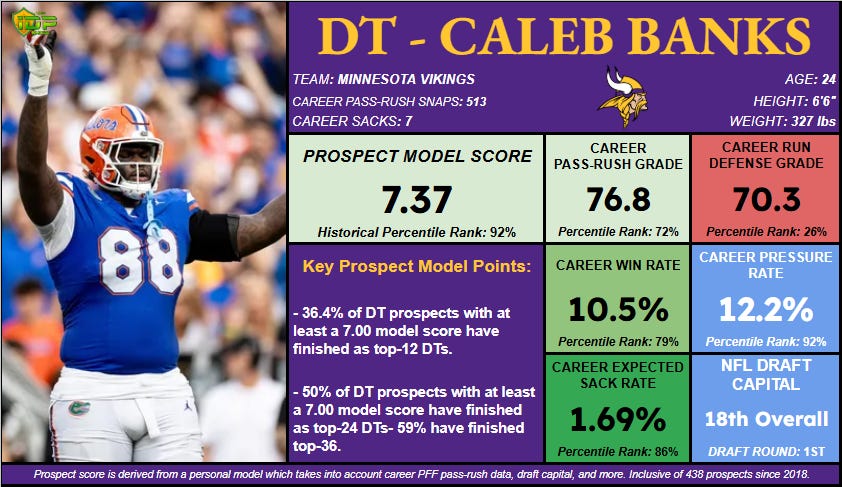
Banks ended up being the first defensive tackle drafted in this year’s class, despite concerns of a foot injury that kept him from playing much in 2025.
Much like Peter Woods, Banks still projects as a taxi-squad stash for DT-required formats right now.
Banks’ pass-rush metrics are slightly better overall than the previously mentioned Woods, though he suffers from a lower run-defense score, which could hurt his every-down potential early in his NFL career.
Banks lands in a good spot for opportunity, with only Jalen Redmond as an established starter in Minnesota, though it wouldn’t be a surprise to see a heavier rotation in the middle outside of Redmond for a year or two.
With Banks not scoring elite pass-rush marks in his college career, combined with the lower run defense marks, he’ll likely take some time to be an IDP-relevant player, which just makes him a solid stash for DT-required formats for now.
Christen Miller, New Orleans Saints
NFL Draft Capital: 2nd Round, 42nd overall
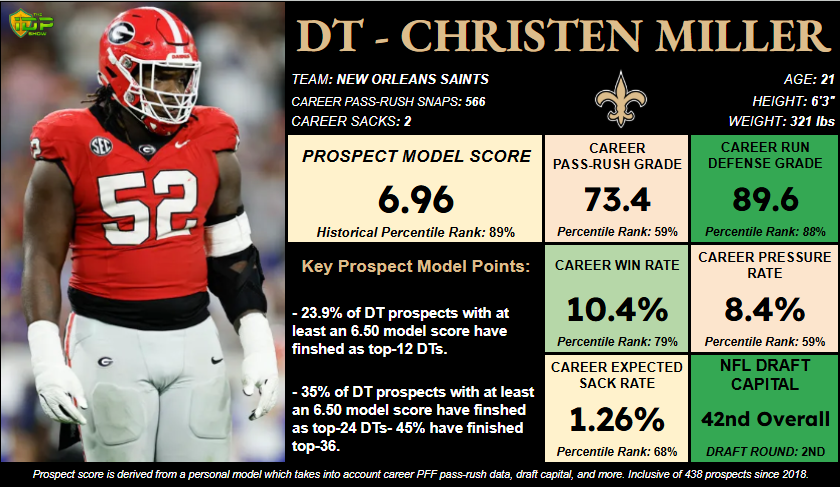
Miller was very unproductive as a pass-rusher in his college career, delivering just two sacks across 566 pass-rush snaps, although sack totals aren’t accounted for in the model, and he was pretty unlucky in that regard.
Miller wouldn’t have likely hit double-digit sacks in his career with better luck, but two sacks in college shouldn’t necessarily be the thing that’s held against him.
Miller’s underlying pass-rush metrics aren’t disastrous by any means, and he’s one of the better run defenders in this class, which helps his overall standing for IDP potential.
His landing spot and draft capital, on top of the fine overall score, combined with the lack of real options in this class, is what pushed him up to DT3 for me, though he’ll purely be a late-round option (Rounds 6-plus) still in DT-required formats.
High-Scoring Later-Round Picks
Kaleb Proctor, Arizona Cardinals
NFL Draft Capital: 4th Round, 104th overall
Current Rookie IDP Ranking: DT8
Proctor delivered an elite 90.4 pass-rush grade in 2025, resulting in 39 pressures and nine sacks this past season.
The asterisk to consider on that production is that he did so in the FCS, where he spent his entire college career, and only posted a pass-rush grade over 68.5 in his final year.
Essentially, this is a player that the model and I will disagree on; even though his prospect model score isn’t that high (6.59), it’s still higher than some drafted ahead of him, even accounting for the level of competition faced.
The Cardinals would likely only use him as part of a rotation as well, which just pushes him out of any real draft range for me in IDP rookie drafts right now.
Lower-Scoring Early-Round Picks
Kayden McDonald, Houston Texans
NFL Draft Capital: 2nd Round, 36th overall
Current Rookie IDP Ranking: DT5
McDonald’s 61.8 career pass-rush grade is the lowest mark for a defensive tackle drafted in the first two rounds since P.J. Hall in 2018 (54.5) – Hall never cracked even the top-36 IDPs at his position and played just three seasons in the NFL.
This isn’t to say that McDonald can’t have success at the next level, but Hall is the only real comparison at this point, because even Jordan Davis, who did not have high-end pass-rush metrics, owned one of the best athleticism scores in recent history.
IDP managers in DT-required formats should likely only really consider McDonald if scoring settings also lean more toward tackle-heavy; otherwise, there’s very little upside in him for IDP.
Lee Hunter, Carolina Panthers
NFL Draft Capital: 2nd Round, 49th overall
Current Rookie IDP Ranking: DT6
Hunter isn’t exceptional in any one particular metric, which ultimately hurts his standing in the model (6.39) and, in turn, his IDP potential.
Hunter blends in with a lot of past Day 2 prospects coming out of college with a similar score – the large majority of whom have yet to deliver any real IDP value.
Among 20 past prospects to score between 6.50 and 7.00 in the model and drafted within the first two days (Rounds 1-3) of the draft, only one (5%), Harrison Phillips, has managed a top-12 IDP finish for his position.
There has been one other (B.J. Hill) to crack the top-24 and two more to crack the top-36, but the point is that for IDP purposes, it isn’t promising to not stand out in the crowd here.
Be sure to subscribe to The IDP Show on Apple, Spotify, or YouTube.
You can follow us on all our social media channels, including Twitter, Instagram, and TikTok.